고정 헤더 영역

상세 컨텐츠
본문 제목
25.11.05.Today News : KOSPI Plunges, Sidecar Triggered as Won-Dollar Rate Briefly Tops 1,450
본문
반응형
KOSPI Plunges, Sidecar Triggered as Won-Dollar Rate Briefly Tops 1,450
📍AI Bubble Fears and Overvaluation Pressure Shake Market; Retail Buyers Step In to Limit Losses
Korean stocks plunged sharply amid rising concerns over a U.S.-driven “AI bubble” and short-term overvaluation. The KOSPI fell more than 6% intraday, dropping below 3,900 and triggering a “sidecar” halt for the first time in seven months. Meanwhile, the won-dollar exchange rate briefly surpassed 1,450, signaling deepening depreciation pressure on the Korean won.

🔹 KOSPI and KOSDAQ Plunge, Sidecar Activated Amid Market Volatility
The KOSPI closed at 4,004.42, down 2.85%, after tumbling as much as 6.16% during early trading to 3,867.81. The KOSDAQ dropped 2.66% to 901.89, hitting an intraday low near 870 as investor sentiment weakened sharply.
Foreign investors sold over ₩3.1 trillion in stocks, while retail investors bought nearly ₩3.1 trillion, helping cushion the losses. Major blue-chip stocks such as Samsung Electronics, SK Hynix, and Hyundai Motor all declined sharply, while semiconductor stocks faced strong selling pressure after months of rapid gains.
🔹 Both KOSPI and KOSDAQ Trigger Sell-Side Sidecar
At 9:46 a.m., a sell-side sidecar was activated as KOSPI200 futures plunged over 5%. A similar halt followed in the KOSDAQ futures market at 10:26 a.m. — the first for KOSDAQ this year.
The sidecar mechanism halts program trading for five minutes when volatility exceeds specific thresholds, serving as an emergency measure to prevent panic selling and excessive price swings.
🔹 AI Bubble Fears, Short-Term Overheating Drive Sharp Correction
The market downturn was largely driven by global fears of an “AI bubble” and profit-taking after a steep rally in semiconductor and tech-related stocks.
On Wall Street, Palantir shares fell nearly 8%, while NVIDIA, AMD, TSMC, and Micron all posted losses of 3–7%. The NASDAQ index dropped more than 2%, sparking a ripple effect across Asian markets.
Lingering uncertainty over the Federal Reserve’s December rate decision, weak demand from China, and rising geopolitical tensions in the Middle East added further downward pressure on investor sentiment.
🔹 Won-Dollar Rate Briefly Tops 1,450, Reflecting Strong Dollar Trend
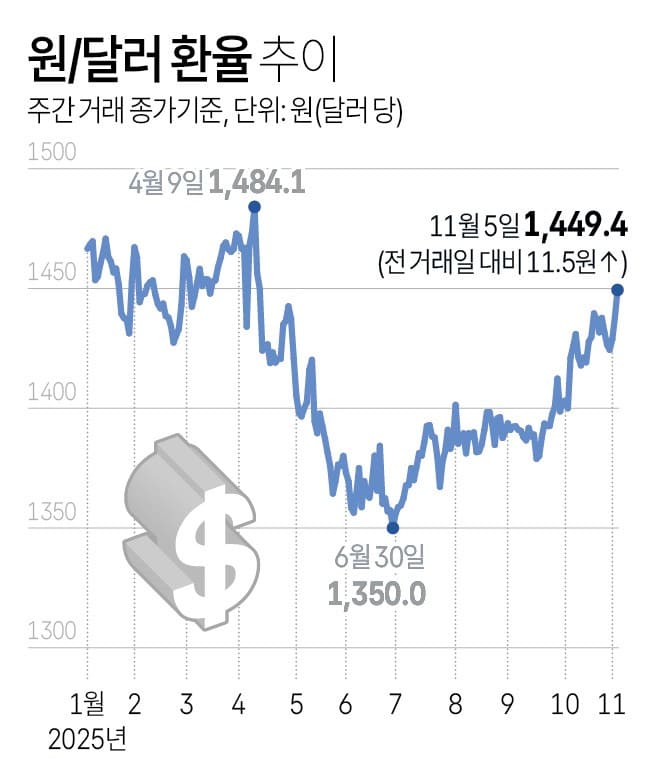
The won-dollar exchange rate surged to 1,449.4 at close, briefly exceeding 1,450 intraday — the highest level in seven months.
The depreciation was fueled by heavy foreign outflows and a stronger U.S. dollar, with the dollar index (DXY) climbing above 100 for the first time in three months.
Concerns over a potential U.S. government shutdown and reduced expectations of a December rate cut boosted demand for the greenback as a safe-haven asset. Despite recent verbal interventions by Korean authorities, analysts warn that sustained foreign outflows could push the won even weaker if the exchange rate remains above 1,450.

One-line summary : Korean stocks plunged amid U.S. AI bubble fears, triggering a sidecar halt, while the won briefly topped 1,450 per dollar.
728x90
반응형
그리드형(광고전용)
댓글 영역