고정 헤더 영역

상세 컨텐츠
본문 제목
South Korea Court Labels 12·3 Martial Law a 'Self-Coup,' Sentences Former Justice Minister to 25 Years
본문
반응형
[26.06.22] 'Involvement in 12·3 Insurrection' Former Justice Minister Park Sung-jae Sentenced to 25 Years, Placed Under Court Custody
The price paid by the head of the Ministry of Justice—the very institution tasked with safeguarding constitutional order and the rule of law—for actively aligning with an unconstitutional martial law was severe. Former Justice Minister Park Sung-jae, indicted on charges including playing a vital role in an insurrection and abuse of power during the December 3, 2024 martial law incident, was sentenced to 25 years in prison in his first-instance trial on June 22. This sentence is 5 years heavier than the 20-year prison term demanded by the Special Counsel team led by Cho Eun-seok. Finding a high risk of evidence destruction, the court immediately placed Park under court custody. Meanwhile, the highly controversial charges regarding his alleged interference in the investigation of First Lady Kim Keon-hee and the perjury charges against former Legislation Minister Lee Wan-gyu were dismissed on purely jurisdictional grounds. Based on all submitted facts, we meticulously dissect the significance and major contentions of this historic ruling.

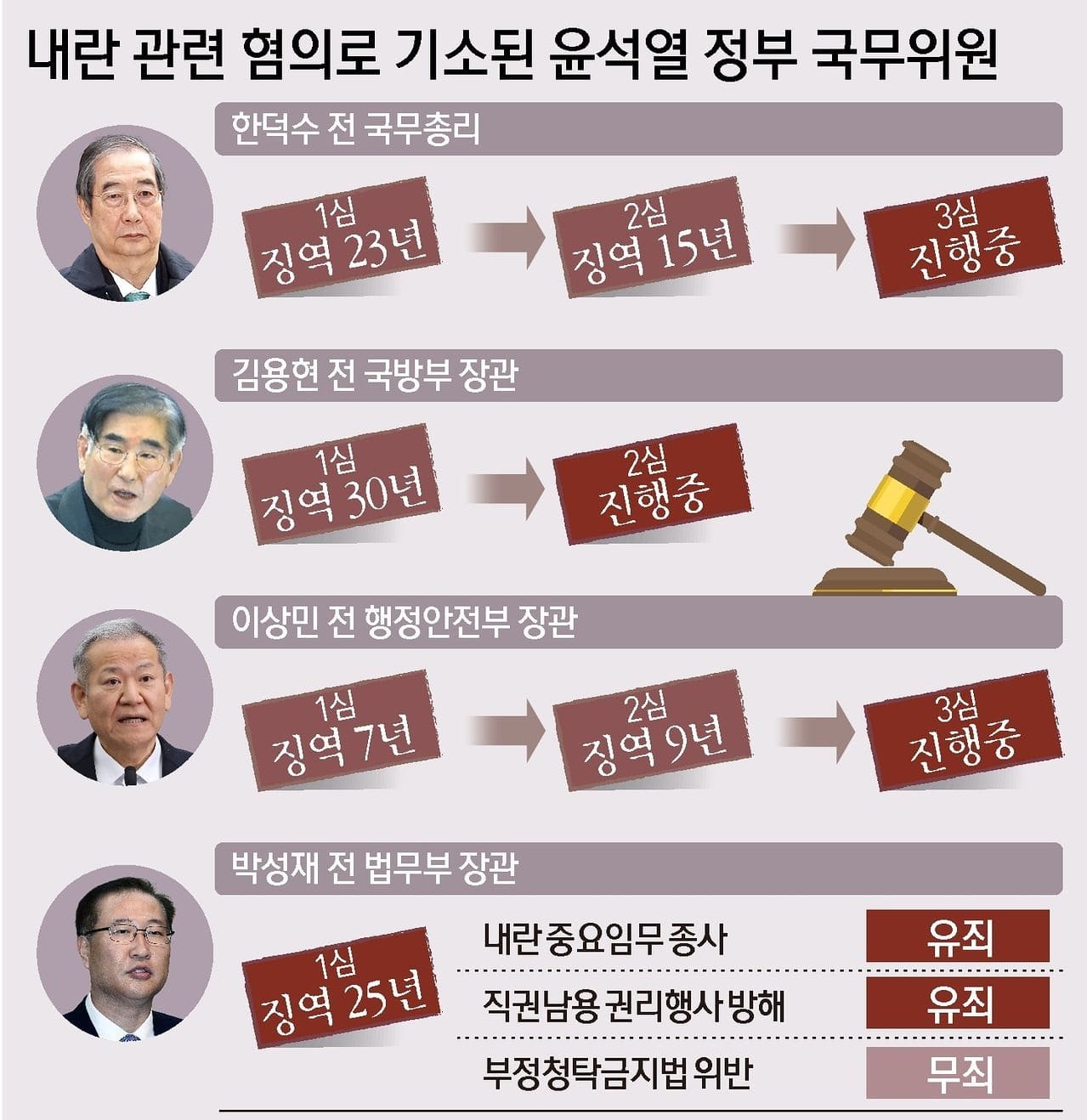
📌 Comprehensive Summary of Former Justice Minister Park Sung-jae's 1st-Instance Verdict
| Category | Major Trial Outcomes & Key Details | Detailed Remarks & Related Cases |
|---|---|---|
| The Court & Date | Seoul Central District Court, Criminal Affairs Division 33 (Presiding Judge Kim Yoo-sung / In-gwan) | Sentencing rendered at 2:00 PM on June 22, 2026 |
| 主要 유죄 혐의 (Guilty Verdicts) | Engaging in a Vital Role in an Insurrection (Criminal Act), Abuse of Official Authority | Sentenced to 25 years in prison (Immediately detained in court) |
| vs. Prosecution Demand | Insurrection Special Counsel Team (Special Counsel Cho Eun-seok) demand: 20 years | The court aggravated the sentence by an additional 5 years |
| Dismissal of Indictment (1) | Park Sung-jae: Interference in First Lady Kim Keon-hee's case (Violation of Anti-Graft Act) | Dismissed as it falls outside the scope of the Insurrection Special Counsel Act |
| Dismissal of Indictment (2) | Lee Wan-gyu (Former Legislation Minister): Perjury before the National Assembly | Dismissed for claiming the 'safehouse meeting' was just a "social gathering" |
| Post-Verdict Reactions | Park's camp: "Immediate appeal" / Special Counsel (Asst. Counsel Zhang Wu-seong): "Low chance of appeal" | Dismissed allegations are expected to be transferred to the '2nd Comprehensive Special Counsel' |
1. Former President Yoon's Scope of Insurrection and Park's 'Sequential Conspiracy'
The ultimate turning point in this trial was whether former Minister Park Sung-jae recognized the emergency martial law as an "unconstitutional, illegal crime of insurrection" and chose to align with it anyway. Criminal Affairs Division 33 provided a clear-cut answer. The court explicitly defined former President Yoon Suk-yeol's actions on December 3, 2024—mobilizing military forces and issuing decrees—as a "riot staged with the intent to subvert the constitutional order," which constitutes a textbook crime of insurrection under the Criminal Act.
Crucially, the court shed light on the events leading up to the declaration. It ruled it reasonable to believe that right before the declaration, President Yoon summoned Minister Park to the presidential office, explicitly mentioned the ongoing 'Myung Tae-kyun case' investigation, and revealed his plan to declare emergency martial law to suppress it. This indicates that Park was fully aware that the emergency martial law completely lacked substantive and procedural requirements, and that Yoon intended to forcibly paralyze the functions of the National Assembly. Consequently, the court found that Park possessed a clear intent to subvert the constitutional order and recognized the illegality of the act, establishing that he sequentially conspired and participated in Yoon's crime of insurrection.
2. The Urgent Chain of Events on Dec 3 and the Order for 'Abuse of Power Documents'
According to the court's findings, Park's track record on the night of December 3 was too concrete and organized to be defended as the routine execution of ministerial duties. The moment emergency martial law was declared, he immediately convened a meeting of senior Ministry of Justice officials to orchestrate a series of executive operations for the insurrection:
- Dispatching Prosecutors to the Joint Investigation HQ: He ordered the evaluation and preparation of dispatching prosecutors to the Martial Law Command's Joint Investigation Headquarters to swiftly crack down on opposition forces.
- Securing Prison Capacities: He instructed officials to audit and secure open cells across national correctional facilities to prepare for the mass detention of decree violators and political opponents.
- Emergency Summon of Exit Ban Personnel: He ordered immigration staff handling exit bans to immediately report to work in the middle of the night to prevent key targets and political dissidents from escaping the country.
Park's criminal conduct persisted even after the martial law was lifted. When the National Assembly voted to neutralize the decree, he abused his official authority by ordering public officials in the Prosecution Bureau of the Ministry of Justice to draft a 'Jurisdiction Abuse Document' containing legal arguments to justify the unconstitutional martial law. Former President Yoon subsequently used the contents prepared by these officials to deliver a public address, fiercely arguing for the legitimacy and inevitability of the insurrection. The court ruled all of these actions as a blatant abuse of power and active participation in a vital role of an insurrection.
3. "Insurrection from Above, a Self-Coup"... The Court's Historic Reprimand
Presiding Judge In-gwan did not mince words, directly labeling the incident the '12·3 Insurrection' and a 'Self-Coup (Insurrection from Above)'. The court emphasized that when an elected leader—entrusted by the public to defend the constitution—becomes the perpetrator and destroys the rule of law, the gravity and danger cannot be compared to a typical bottom-up civil uprising. It fundamentally shatters the public's faith in democracy.
"The mission executed by the defendant served as an essential prerequisite to achieve the goals of the 12·3 Insurrection—specifically by neutralizing political opponents to block the National Assembly's demand to lift martial law. Due to the defendant's actions, the Republic of Korea was on the verge of regressing into a dark past where the basic democratic order was violated, leaving the nation trapped in the quagmire of dictatorship for an extended period."
Furthermore, the court heavily penalized Park for his deceptive attitude throughout the trial. He repeatedly provided false statements to investigative bodies and the court. Despite objective, undeniable evidence—such as CCTV footage documenting his orders to inspect prison capacities—he stubbornly resorted to evasive defenses, claiming he had "no recollection whatsoever." Although Park offered a brief verbal apology during his final examination, stating he "felt deep responsibility and regret," the court dismissed it as disingenuous. Consequently, the court handed down a 25-year prison sentence—5 years harsher than the special counsel's request. This is notably heavier than the 23-year sentence handed down to former Prime Minister Han Duck-soo by the same division in January.
4. Interference in First Lady Kim Keon-hee's Case and the Safehouse Perjury: The Legal Logic of 'Dismissal'
Another massive point of contention in this trial was the allegation that in May of last year, Park received a direct phone call from First Lady Kim Keon-hee asking him to "look into how the special investigation team regarding the luxury pouch receipt allegation was formed at the Seoul Central District Prosecutors' Office." Park then allegedly issued improper directives to subordinates to interfere, violating the Anti-Graft Act. Alongside this, former Legislation Minister Lee Wan-gyu was tried for committing perjury before the National Assembly by falsely testifying that the 'safehouse meeting'—suspected of being the birthplace of the martial law plot—was merely a "friendly social gathering."
However, the court declared a 'Dismissal of Public Prosecution' (공소기각) for these specific charges, terminating the litigation without evaluating whether the defendants were guilty or innocent. This was a purely formal legal determination based on the limits of the special counsel's jurisdiction. The court ruled that the statutory scope of Cho Eun-seok's Insurrection Special Counsel team is strictly limited to "crimes directly related to the emergency martial law, insurrection, and treason." It concluded that the Telegram messages triggering the investigation into Park's graft charges and the perjury surrounding the safehouse meeting lacked a concrete, causal connection to the 12·3 insurrection itself.
[The Court's Supplementary Legal Opinion on the Dismissal]
"For reference, if a dismissal of public prosecution becomes finalized, it remains completely permissible under due process to re-investigate and re-indict the defendants through appropriate channels, thereby harmonizing the principle of due process with the discovery of substantive truth."
In short, while it was procedurally flawed to prosecute these crimes under the current Insurrection Special Counsel framework, the court left the door wide open for regular investigative authorities or a new specialized special counsel to re-indict them in the future.
5. "Immediate Appeal" vs "Transfer to 2nd Special Counsel"... Severe Political Fallout
The political and legal landscape fractured instantly following the verdict. Park’s defense counsel released a statement expressing deep dissatisfaction: "This is a judgment where the interpretation of legal principles and the recognition of facts are entirely unacceptable." They announced plans for an immediate appeal, maintaining their stance that Park was merely performing routine administrative duties during a national emergency, completely devoid of any intent to stage an insurrection.
Conversely, the Special Counsel team expressed strong satisfaction. Assistant Special Counsel Zhang Wu-seong stated in a briefing, "The judiciary has clearly outlined the heavy constitutional duties of a Justice Minister to stop unconstitutional martial law declarations and protect the constitutional order." Because the court handed down a sentence exceeding their original demand, the Special Counsel team is highly unlikely to file an appeal regarding the insurrection counts. Regarding the dismissed charges involving First Lady Kim Keon-hee and Lee Wan-gyu, Zhang noted, "We will assess whether these cases align with the mandate of the upcoming '2nd Comprehensive Special Counsel Team.' If we can seamlessly transfer these files, we will forgo an appeal on the dismissal and instead place them onto a proper, dedicated track for re-investigation."
📝 Final In-Depth Summary: Former Justice Minister Park Sung-jae, who turned a blind eye to the unconstitutional 12·3 emergency martial law and mobilized state machinery to assist it, has been sentenced to 25 years in prison—overriding the special counsel's 20-year demand—and placed under immediate court custody. The judiciary fiercely condemned the incident as a malicious 'self-coup' that endangered the democratic fabric of the nation. Although the allegations involving First Lady Kim Keon-hee's investigation interference and former Minister Lee Wan-gyu's perjury were dismissed due to the special counsel's jurisdictional boundaries, the court explicitly noted the potential for re-investigation. As these cases loom over the horizon for the upcoming 2nd Comprehensive Special Counsel, the legal and political crisis surrounding these figures is only expected to intensify.
728x90
반응형
그리드형(광고전용)
'오늘의 일들 > Korea Today's News' 카테고리의 다른 글
| World Cup Broadcast Secured, But JTBC Faces Appearance Fee Delays (0) | 2026.06.24 |
|---|---|
| JTBC Faces World Cup Blackout Over Unpaid Fees (0) | 2026.06.23 |
| Lawyer Who Extorted Tzuyang Ordered to Pay 73.1M Won (0) | 2026.06.21 |
| Incheon Knife Attack: State Ordered to Pay 350M Won (0) | 2026.06.20 |
| S. Korea’s JoongAng Ilbo Declared in Default, Rating Cut to 'D' (0) | 2026.06.19 |
댓글 영역