고정 헤더 영역

상세 컨텐츠
본문 제목
'Heat Dome' Traps Korea at 39.3°C: Casualties and Livestock Losses Mount
본문
반응형
[26.07.26] Nationwide 'Sweltering Heatwave'… Severe Heatwave Warnings Expanded Amid Escalating Heat Illnesses and Livestock Losses
A double high-pressure system hovering over the Korean Peninsula has triggered a severe 'heat dome' phenomenon nationwide. With daytime temperatures in Yangsan and Miryang hitting 39.3°C—breaking the record for the highest temperature in the nation this year—the highest warning tier, 'Severe Heatwave Warning' (폭염중대경보), has been expanded across Honam and Yeongnam. The country is on high alert as heat-related casualties and livestock deaths continue to mount.

1. Daytime Temps Soar to 39.3°C… Highest-Tier 'Severe Heatwave Warning' Expanded Nationwide!
According to the Korea Meteorological Administration (KMA), daytime temperatures in Yangsan and Miryang, Gyeongsangnam-do, soared to 39.3°C on the 26th, setting a new national high for the year. Sweltering heat gripped the southern regions, with Gwangyang-eup recording 38.1°C (perceived temperature 38.3°C), Hwangjeon in Suncheon reaching 37.4°C, and Chosun University in Gwangju hitting 36.5°C.
Heuksando in Sinan recorded 34.3°C, breaking the all-time record for the highest daily temperature in July. Detailed measurements across various observation stations also showed alarming figures:
- Suncheon (Hwangjeon): Perceived temperature 36.4°C
- Boseong (Beolgyo): Perceived temperature 36.6°C
- Goheung (Podu): Perceived temperature 36.5°C
- Gwangyang City: Maximum temperature 36.4°C (5th highest on record)
As of 11:00 AM on the same day, the KMA immediately upgraded the Heatwave Advisory to a Heatwave Warning for 8 regions in Jeollanam-do, including Jangseong, Gangjin, Yeongam, Naju, and Heuksando.
Given the severity, the KMA issued an extensive expansion of the 'Severe Heatwave Warning'. Joining Gwangyang, Yangsan, and Uiryeong, major regions across Yeongnam and Honam—including Gimhae, Miryang, Haman, Changnyeong, Hapcheon, Pohang, Gyeongju, Goryeong, Gyeongsan, Cheongdo, and Daegu—were included in the upgraded alert.
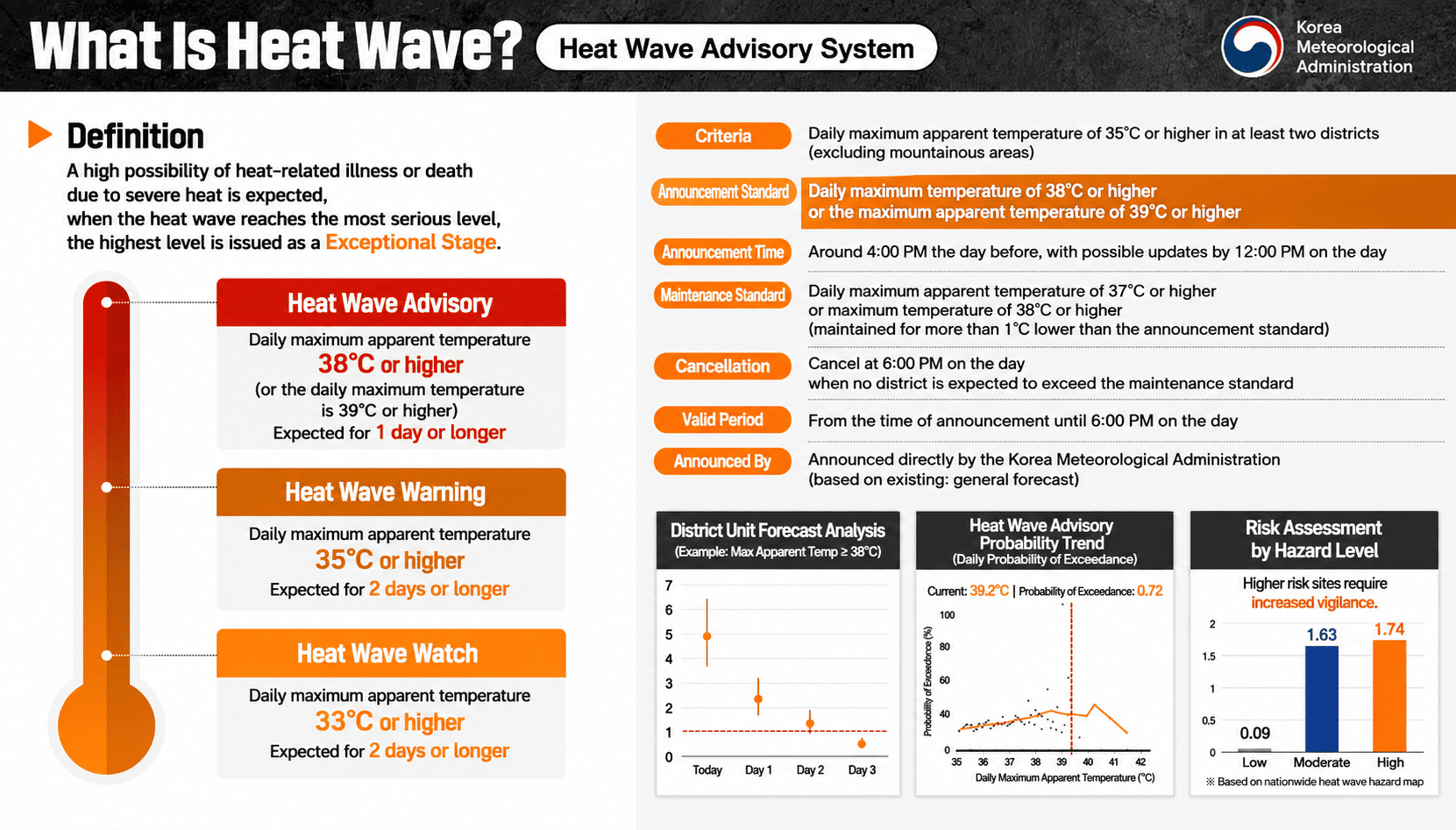
Newly introduced this year, the Severe Heatwave Warning is the highest alert level, issued when perceived temperatures are expected to stay above 38°C or maximum temperatures exceed 39°C. It is triggered under extreme high-temperature conditions when maximum perceived temperatures remain at 35°C or higher for two or more consecutive days.
Over the weekend, perceived temperatures surged to around 36°C across most parts of the country, including the Seoul Metropolitan Area, Gangwon, Chungcheong, and Jeju. The epicenter of the extreme heatwave has broadened significantly, moving from its traditional focus in Daegu to encompass all of inland Gyeongbuk and southern Honam.
Meteorologists attribute this extreme heat wave to a double high-pressure structure, where the Tibetan High in the upper atmosphere and the North Pacific High in the middle-to-lower atmosphere overlay the Korean Peninsula simultaneously. Heat trapped beneath this dome prevents nighttime cooling, leading to consecutive 'Tropical Night Advisories' in areas like Busan, Geoje, and Yangsan for over ten straight days.
The North Pacific High supplies continuous hot and humid moisture to the lower atmosphere, driving up perceived heat. Meanwhile, the Tibetan High acts as a massive roof in the upper layer, preventing trapped heat from escaping into space.
Consequently, nighttime temperatures in Yangsan and Geoje (since the 16th) and Busan (since the 19th) have failed to drop, keeping tropical night conditions unbroken.
Yangsan and Miryang exceed 39.3°C! The 'Heat Dome' phenomenon caused by a double high-pressure system has prompted a nationwide expansion of Severe Heatwave Warnings.
2. Farmworker Collapses and Dies… Heat Illnesses Surpass 1,300 Nationwide Amid Mounting Casualties
As the heatwave persists, casualties among outdoor workers and the elderly are rising sharply.
- Hwangsan-myeon, Haenam-gun: A Thai farmworker in his 30s collapsed while working in a field and later passed away (showed high body temperature symptoms upon discovery; Haenam reached 33.7°C that day).
- Sacheon, Gyeongsangnam-do: A man in his 90s died of multiple organ failure caused by heatstroke (2nd heatwave death in Gyeongnam this summer).
- Goseong-gun, Gyeongsangnam-do: Recorded the state's first heat illness fatality of the summer on the 22nd.
- Sora-myeon, Yeosu: A crew member in his 50s aboard a fishing vessel was emergency transported due to heatstroke symptoms.
On the afternoon of the 26th, an 80-year-old man collapsed unconscious in a field in Doam-myeon, Hwasun-gun, with a body temperature of 40.4°C. In Okcheon-myeon, Haenam-gun, a person in their 60s was rushed to the emergency room suffering from hyperthermia.
According to the Korea Disease Control and Prevention Agency (KDCA) emergency room surveillance system, cumulative heat illness cases have surpassed 1,300 (1,301 cases). Paramedics who treated the 80-year-old man in Hwasun recorded his body temperature well over a critical 40°C.
On July 25 alone, 11 new heat illness cases were reported in the Jeonnam and Gwangju areas. Nationwide, 1,232 patients had been reported as of July 23, with 5 fatalities confirmed.
The distribution of cases by region is as follows:
- Gyeonggi-do: 271 cases
- Gyeongbuk: 145 cases
- Seoul: 122 cases
- Gyeongnam: 112 cases
- Jeonnam / Gwangju: 109 cases
Health experts strongly advise against outdoor labor during midday, pointing out that nearly 30% of agricultural heat illness cases occur between the last week of July and the first week of August. Over the past three years, 28.9% of agricultural heat casualties coincided with this specific period.
In Chungnam, four heat illness patients were reported in a single day, reflecting a clear nationwide trend. With cumulative figures rising rapidly since surveillance began on May 15, the KDCA re-emphasized strict adherence to safety guidelines.
Heat illnesses surpass 1,300 nationwide! Fatalities during agricultural labor and hyperthermia cases highlight the urgent need to halt outdoor activities during midday.
3. Over 16,000 Livestock Perish and Tourist Spots Deserted… Agricultural and Industrial Sectors in Full Fight Against Heat
The heatwave is dealing a severe blow to livestock farms and local economies. As of the 24th, 101 farms in Jeonnam and Gwangju reported 16,378 livestock deaths, including 12,283 chickens, 2,360 ducks, and 1,735 pigs, with preliminary damages estimated at 275 million KRW.
Losses have hit poultry and pigs particularly hard due to their vulnerability to extreme heat, increasing anxiety among local farmers. Preliminary damage figures submitted to local governments are expected to rise as further reports are processed. Livestock owners are working around the clock to lower mortality rates.
Farmers are deploying all available resources, running rooftop water sprinklers, giant industrial fans, and misting systems at full capacity. Agricultural workers are also adjusting their working hours to early morning or after sunset.
A local farmer shared that he limits essential work to dawn or sunset to avoid peak temperatures. Spraying water continuously on barn roofs to lower internal temperatures has become a common practice. Local governments are accelerating support by dispatching water tanker trucks and supplying heat mitigation equipment.
Meanwhile, popular weekend tourist destinations like Hwangridan-gil in Gyeongju were unusually quiet as visitor foot traffic plummeted. Conversely, crowds flocked to indoor air-conditioned facilities, including shopping malls, cultural centers, beaches, valleys, and water parks.
A tourist visiting Gyeongju expressed frustration, mentioning that stepping outside felt suffocating, forcing them to alter their itinerary to indoor attractions. Pedestrian shade canopies at crosswalks were crammed with citizens trying to escape the blistering sun. The weekend vacation landscape presented a sharp contrast as people sought refuge indoors and at water venues.
Over 16,000 livestock perished! Fully operational barn misting systems, deserted outdoor tourist spots, and overcrowded indoor facilities create a stark contrast.
4. Unrelenting Heat near 38°C to Continue This Week… KMA Urges "Hydration and Minimizing Outdoor Exposure"
According to KMA forecasts, relentless extreme heat and tropical nights will persist throughout this week.
- July 27 (Mon): Morning Lows 25–26°C / Daytime Highs 28–36°C
- July 28 (Tue): Daytime Highs soaring to 38°C (Peak heat wave intensity of the week)
- July 29 (Wed): Daytime Highs remaining between 30–37°C
A KMA official stated, "Because temperatures will not drop significantly overnight, tropical nights will be widespread across most regions. Please keep indoor spaces cool using air conditioners or fans and consume sufficient fluids regularly."
Morning temperatures across Honam and key areas like Gwangyang are expected to stay above 25°C, sustaining persistent tropical nights. The KMA announced that Tropical Night Advisories remain active across Gwangju and all of Jeonnam, excluding the Gurye mountain regions. Maintaining proper indoor temperature and humidity while ensuring routine ventilation during air conditioner use is recommended.
The agency re-emphasized, "When perceived temperatures reach 33°C or higher, cease outdoor activities immediately and rest. Extra precautions must be taken for vulnerable groups, including the elderly, low-income households, and outdoor construction or agricultural workers."
To prevent heat-related illnesses, people should drink fluids regularly before feeling thirsty. Avoiding outdoor labor or workouts between noon and 5:00 PM—the hottest hours of the day—is crucial. Health authorities and local governments have significantly reinforced welfare checks on vulnerable groups, such as elderly living alone, while expanding cooling shelter operations.
| Category | Key Overview & Detailed Status |
|---|---|
| 1. Major Temp Records | Yangsan & Miryang 39.3°C (Yearly national high), Gwangyang 38.1°C, Heuksando 34.3°C (July record) |
| 2. Alert Status | 'Severe Heatwave Warning' expanded across Gyeongnam, Gyeongbuk, & Jeonnam; Tropical Night Advisories in effect |
| 3. Heat Illness Casualties | 1,301 cumulative cases nationwide (Gyeonggi 271, Gyeongbuk 145, Seoul 122, Gyeongnam 112, Jeonnam 109) with fatalities |
| 4. Livestock Damage | 16,378 livestock perished across 101 farms in Jeonnam (poultry, pigs, etc.); ~275 million KRW estimated loss |
| 5. Forecast Outlook | Daytime highs of 32–38°C through the week; prolonged extreme heat and tropical nights expected |
[Key Summary] Top 5 Takeaways on the Nationwide Heatwave Crisis
1. Temps Surge to 39.3°C: Yangsan and Miryang break national records for the year, with perceived temperatures near 38°C nationwide!
2. Expansion of Severe Warnings: Highest-tier heatwave alerts issued nationwide due to the dual high-pressure 'Heat Dome'!
3. Over 1,300 Heat Illnesses: Fatalities reported in Haenam, Sacheon, and other areas; high alert for agricultural and outdoor work!
4. Escalating Livestock Damage: Over 16,000 farm animals perished; farmers in full emergency control with rooftop cooling!
5. Prolonged Heat This Week: Scorching heat around 38°C forecast to continue; hydration and avoiding outdoor exposure are vital!
Related Tags (9): July 26 2026, Severe Heatwave Warning, Korea Heatwave, Heat Illness, Gwangyang Weather, Yangsan Temperature, Tropical Night Warning, KMA, Heatwave Damage
728x90
반응형
그리드형(광고전용)
댓글 영역