고정 헤더 영역

상세 컨텐츠
본문 제목
[26.03.27] Korea Plans 10,000 Won Cigarettes, Expands Youth Health and Climate Policies
본문
반응형
Government to Strengthen Youth Health Management…Cigarette Prices to Rise to 10,000 Won Range, Alcohol Levy Under Review
📍National Health Promotion Plan approved…health lifespan target of 73.3 years maintained, focus on reducing inequality and climate response
The government has unveiled a new national health policy blueprint centered on strengthening youth health management and responding to the climate crisis. As plans to raise cigarette prices to the level of OECD countries and newly impose health levies on alcohol are being reviewed, significant changes in everyday life are expected. In particular, the policy focus is shifting toward improving “health equity,” including separating youth mental health and vulnerable group support into dedicated tasks.

🔹 Sixth health plan finalized…goal of “lifelong healthy society”
The Ministry of Health and Welfare held the National Health Promotion Policy Committee meeting on the 27th and approved the “6th Comprehensive National Health Promotion Plan (2026–2030).”
This plan supplements the existing 5th plan and sets the vision of “a society where everyone enjoys lifelong health.”
The key goals are extending healthy lifespan and reducing health disparities by income and region.
🔹 Reflecting decline in healthy lifespan…focus on narrowing gaps
The government decided to maintain the 2030 healthy lifespan target at 73.3 years.
However, healthy lifespan declined from 70.9 years in 2020 to 69.9 years in 2022, falling below 70 for the first time in nine years.
The gap with life expectancy widened to 12.8 years, and disparities by income level have also increased.
Accordingly, the government aims to reduce the gap between the top 20% and bottom 20% income groups to 7.6 years or less, and regional disparities to 2.9 years or less.
🔹 Youth health as separate priority…expanding mental health support
The government identified youth as a critical stage where health disparities begin to form and designated it as a separate policy priority.
It plans to expand mental health screenings for all young people and improve access to treatment through initial medical cost support.
For vulnerable youth such as those preparing for independence, family caregivers, and socially isolated individuals, customized health services will be provided, along with in-depth surveys of underserved groups.
🔹 Climate crisis health policy newly established
The plan newly includes “health response to the climate crisis” as a policy pillar.
To address risks such as heatwaves, cold waves, and emerging infectious diseases, the scope will expand beyond infectious diseases to include chronic conditions and mental health.
The government plans to establish emergency care systems, strengthen health impact monitoring, and expand psychological support for victims and response personnel through inter-ministerial cooperation.
🔹 Strengthening chronic disease management…expanding primary care role
Chronic disease management has also been separated as a key priority.
The government will strengthen prevention and management systems centered on primary care and develop tailored strategies for major diseases.
Institutional frameworks such as committee structures will also be established to ensure continuous management.
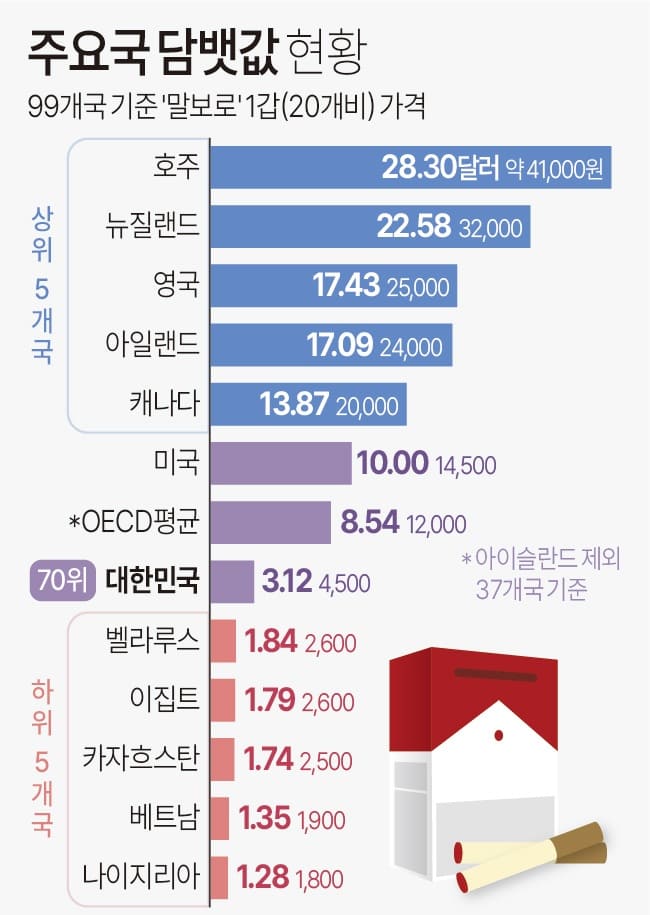
🔹 Raising cigarette prices…possible move to 10,000 won level
The government plans to increase the health promotion levy imposed on tobacco under the National Health Promotion Act.
Domestic cigarette prices have remained at 4,500 won since the 2015 increase.
However, considering the OECD average of about 9,869 won, prices in Korea may rise to the 10,000 won range.
Additional measures such as banning flavor additives, restricting advertising, and introducing plain packaging will also be implemented to reduce smoking rates.
🔹 Alcohol levy under review…tightening drinking environment regulations
The government is reviewing expanding the health promotion levy, currently applied only to tobacco, to alcoholic beverages.
It plans to strengthen regulation of content that promotes drinking, such as online “drinking broadcasts,” and expand youth access controls and advertising restrictions.
The aim is to reduce alcohol consumption through pricing policies and manage health risk factors.
🔹 Managing harmful products…securing financial resources
The government plans to reform the levy system on harmful products such as tobacco and alcohol to reduce consumption while increasing funding for the National Health Promotion Fund.
This is interpreted as a strategy not only for regulation but also for strengthening the financial foundation of public health policy.
One-line summary : The government is reviewing higher cigarette prices and alcohol levies to strengthen youth health and climate response.
728x90
반응형
그리드형(광고전용)
댓글 영역