고정 헤더 영역

상세 컨텐츠
본문 제목
Magnitude 7.4 Earthquake Strikes Western Colombia… Over 164 Dead, State of Emergency Declared
본문
반응형
[26.08.11] Magnitude 7.4 Earthquake Strikes Western Colombia… Over 164 Dead, State of Emergency Declared
A massive 7.4 magnitude earthquake has devastated the mountainous region of western Colombia, resulting in at least 164 deaths and over 2,000 suspected missing persons in a severe national tragedy. The newly inaugurated president immediately declared a state of emergency, mobilizing all available resources for search and rescue operations, while the international community rushes to provide relief. Here are five key points detailing the catastrophic event and the ongoing response.
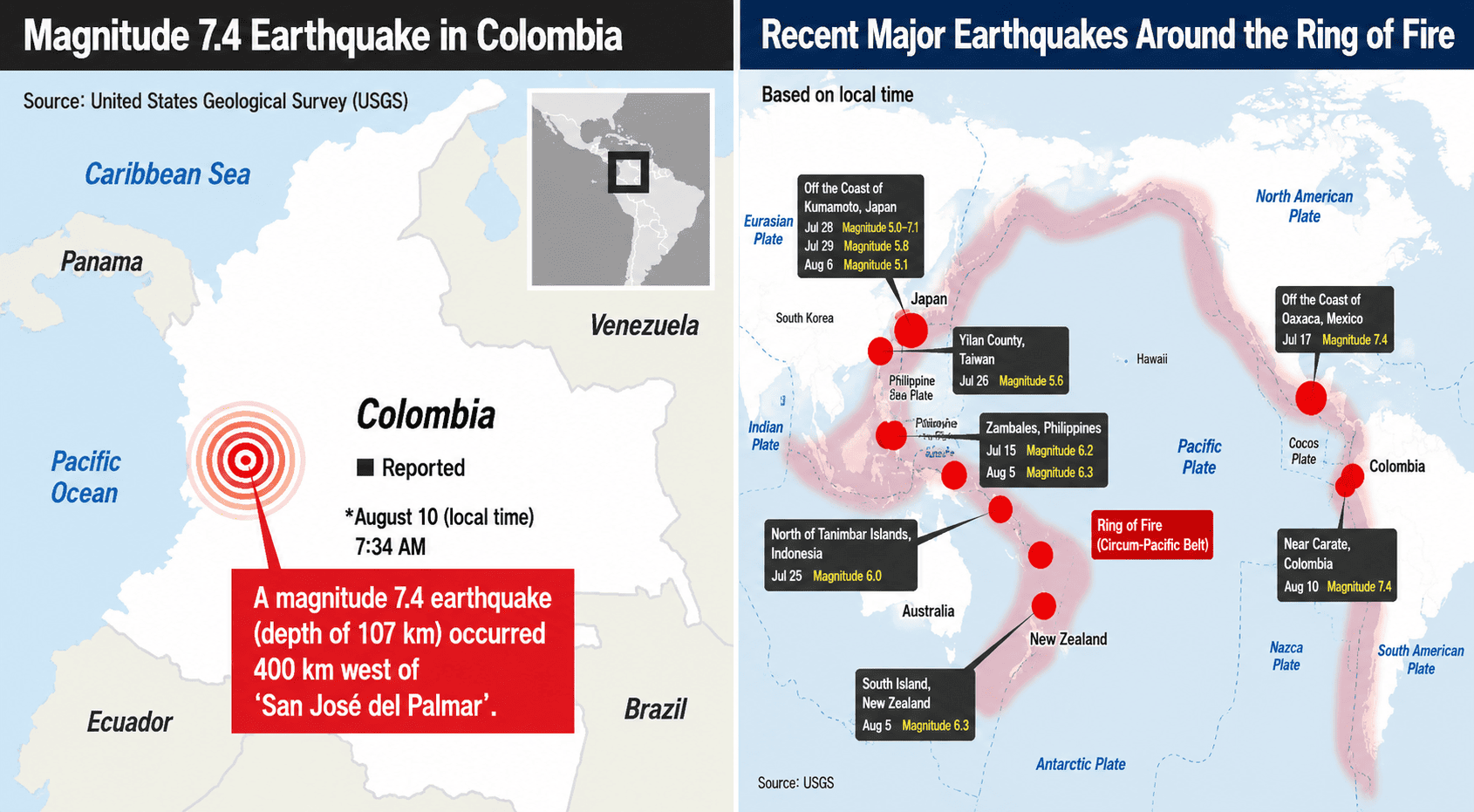
1. The Worst Earthquake of the 21st Century Shakes Western Colombia
According to the United States Geological Survey (USGS), a powerful magnitude 7.4 earthquake struck approximately 5 kilometers east of San José del Palmar in the Chocó department (4.9°N, 76.2°W) at 7:34 AM local time on August 10. The epicenter was estimated at a depth of about 110 kilometers. The massive early morning tremors were strongly felt not only in the capital city of Bogotá but also in neighboring countries, including Ecuador, Panama, and areas bordering Venezuela.
The Colombian Geological Service (SGC) officially announced that this is the largest earthquake to hit Colombia in the 21st century. The New York Times (NYT) also reported it as the most powerful earthquake in the nation in the past decade. Following the initial quake, at least 21 aftershocks were recorded by evening, leaving local residents in a continuous state of terror.
Colombia is located on the Pacific Ring of Fire, a geographic region highly susceptible to frequent seismic and volcanic activity. Geological experts attribute this powerful earthquake to the sudden release of accumulated energy along fault lines caused by the collision of the Nazca and South American tectonic plates, warning that severe aftershocks could persist for several weeks.
Magnitude 7.4 Tremors Felt Across 3 Neighboring Countries! As the largest earthquake to strike Colombia in the 21st century, continuous aftershocks pose a severe threat of further collapses.
2. Casualties Snowball… Over 2,000 Suspected Missing
The damage in the western region, which bore the brunt of the quake, is catastrophic. Provisional death tolls reported by local authorities quickly rose from 111 to at least 164, with injuries surpassing 570. Most alarmingly, due to the high number of people trapped under collapsed buildings, the Associated Press (AP) reported over 2,000 suspected missing person cases.
Infrastructure damage is expanding uncontrollably. Nationwide, over 1,600 houses have been damaged, with 61 completely leveled. Alejandro Eder, mayor of Cali, the country's third-largest city, pleaded for urgent rescue efforts, stating, "At least 20 buildings have collapsed, and people are trapped inside." Luis Gregorio Moreno, a community leader in Quibdó, Chocó, expressed immense despair, noting, "While deaths and injuries are numerous, what overwhelms us most is the sheer number of the missing."
Rescue operations in San José del Palmar and the surrounding western mountainous areas are severely hampered by rugged terrain and earthquake-damaged road conditions, delaying the arrival of excavators and heavy machinery. Consequently, local rescue teams are forced to rely on limited equipment, including shovels and bare hands, to clear debris and search for survivors amid the constant threat of secondary landslides triggered by ongoing aftershocks.
Devastated Cities in a Race Against Time! Thousands of missing persons reports and collapsed medical and educational facilities highlight the desperate nature of the ongoing rescue operations.
3. A National Disaster 3 Days After Inauguration… President Declares 'State of Emergency'
This massive earthquake presents an unprecedented national crisis for Colombia’s newly appointed President, Abelardo de la Espriella, who was officially inaugurated just days ago on August 7. Recognizing the gravity of the situation, the President immediately addressed the nation and declared a state of emergency.
Through the social media platform X, President Espriella ordered the assembly of a unified command center, promising to "personally spearhead the measures to support all affected community areas." In his public address, he strongly urged national unity and rapid response, stating, "The government is mobilizing all available capabilities to protect the lives of our citizens and deliver essential supplies to every region in need of relief."
Immediately following the declaration, the Colombian government allocated initial emergency relief funds coordinated by the National Unit for Disaster Risk Management (UNGRD). Furthermore, over 3,000 military and police personnel have been urgently deployed to the primary disaster zones to prevent security vacuums, assist in life-saving rescues, initiate temporary road repairs, and construct shelters for displaced residents.
Massive Crisis Immediately Following Government Launch! The President is personally operating the crisis command center, initiating an all-out rescue system, including military deployment, under a state of emergency.

4. International Solidarity and Urgent Relief Efforts Shine in Crisis
In response to the tragic news from Colombia, the international community has quickly communicated its intent to provide aid. US Secretary of State Marco Rubio stated that the Trump administration is "closely monitoring the situation and is ready to support the Colombian people." European Commission President Ursula von der Leyen announced the activation of the Copernicus satellite system to assist in rescue operations.
Notably, neighboring Venezuela, which suffered a tragic earthquake in late June resulting in over 6,000 deaths, expressed deep solidarity. Venezuelan opposition leader María Corina Machado offered condolences, emphasizing, "Our people have painfully experienced how crucial international solidarity is when faced with such tragedy." Governments from Israel, Mexico, Ecuador, and France have also lined up to pledge rescue personnel and supplies.
As global relief efforts gain momentum, the UN Office for the Coordination of Humanitarian Affairs (OCHA) has begun actively coordinating the deployment of an emergency damage assessment team to the region. In addition, transport aircraft carrying field medical supplies, water purification equipment, and relief helicopters dispatched from forward bases in neighboring countries are scheduled to arrive at operational airports within Colombia.
From Advanced Satellites to Rescue Teams! International relief infrastructure, ranging from empathetic neighboring nations to the US, EU, and UN agencies, is rapidly mobilizing for Colombia.
5. No Korean Expat Casualties… Damage in Capital Bogotá Remains Limited
Fortunately, it has been confirmed that there are no direct casualties among Korean expatriates currently living in Colombia. Approximately 800 Koreans reside in the country, the vast majority of whom live in the capital, Bogotá, located about 230 kilometers east of the epicenter.
An official from the South Korean Ministry of Foreign Affairs reported, "As of now, no casualties among our citizens have been received. We have only confirmed minor damage, such as internal cracks and slight tilting, in the apartment of one expat family living near the epicenter." Bogotá Mayor Carlos Galán also reassured the public via local radio, explaining that "while there was panic and evacuations following the quake, damage within the capital appears limited mostly to exterior wall cracks," indicating the situation in Bogotá remains under control.
The Embassy of the Republic of Korea in Colombia activated a 24-hour emergency response system immediately following the quake, maintaining a direct hotline with the local Korean association and Colombian police authorities to closely monitor for any potential further damage. The embassy has urgently disseminated safety guidelines for subsequent aftershocks to the expatriate community and strongly advised against traveling to disaster recovery regions or areas at high risk of landslides for the time being.
Korean Community Confirmed Safe, Capital Relatively Stable! Although the powerful tremors reached Bogotá, Korean residents fortunately suffered no casualties under the embassy's emergency monitoring, and physical damage in the capital was minor.
| Category / Issue | Key Status and Detailed Data |
|---|---|
| Event Overview | August 10, 7:34 AM (Local) / Magnitude 7.4 (110km depth) / Largest in the 21st century. |
| Casualties | At least 164 dead, 570 injured, over 2,000 missing (Fears of rising death toll). |
| Infrastructure Damage | 1,600+ homes damaged (61 destroyed), 7 airports closed, 18 medical facilities hit. |
| Gov't Response | President Espriella declared 'State of Emergency', deployed 3,000 military/police personnel. |
| Int'l Aid | US, EU, Venezuela pledge solidarity; UN OCHA coordinates emergency assessment team. |
| Korean Expats | No casualties / 24-hr embassy emergency system active / Bogotá residents mostly unharmed. |
[Disaster Brief Summary] 5 Core Impacts of the 7.4 Magnitude Earthquake in Colombia
- 1. Devastated Western Mountains: Dozens of buildings collapsed in the epicenter province of Chocó and western cities like Cali, paralyzing urban functions.
- 2. Search for the Missing During the Golden Hour: Beyond the 164 confirmed dead, an estimated 2,000 people are trapped in rubble, threatening a massive surge in casualties.
- 3. Swift All-Out War by the New President: Facing a disaster right after inauguration, President Espriella invoked emergency powers and deployed the military to prioritize rescue operations.
- 4. Global Solidarity and Waves of Relief: International aid is pouring in, from US and EU resources to UN agencies and neighboring Venezuela, which recently survived its own massive earthquake.
- 5. Relief for the Expat Community: The 800 Korean residents safely avoided casualties, with the Embassy maintaining an active emergency monitoring network.
Related Tags: ColombiaEarthquake, Magnitude7.4, ChocoProvince, SanJoseDelPalmar, StateOfEmergency, AbelardoDeLaEspriella, EarthquakeDamage, RescueOperations, InternationalAid, 2026_August_11
728x90
반응형
그리드형(광고전용)
댓글 영역