고정 헤더 영역

상세 컨텐츠
본문
반응형
[26.08.10] Actress Ha Young Faces Backlash Over Pro-Japanese Allegations Against Great-Grandfather An Sang-ho
Actress Ha Young (33, real name An Ha-young) is facing severe public criticism after boasting about her 'four-generation doctor family' on a TV show, bringing her great-grandfather's alleged pro-Japanese past to light. While her agency acknowledged her relation to doctor An Sang-ho, they dismissed the pro-Japanese allegations as "groundless." However, the controversy has expanded across five key issues as historical archives and expert statements contradicting the agency's denial continue to surface.

1. "Four Generations of Doctors" on TV and the Elite Physician An Sang-ho
During her appearance on KBS 2TV's variety show 'Problem Child in House' on August 7, Ha Young revealed that her family has practiced medicine for four generations, spanning from her great-grandfather to her sister. Expressing pride, she noted that her great-grandfather studied medicine in Japan, opened one of Hanyang's earliest Western clinics, and treated Emperor Gojong. Online sleuths quickly identified this individual as the prominent physician An Sang-ho.
Historical records show that An Sang-ho was a top elite medical professional of his time. He graduated from Tokyo Jikei University School of Medicine in 1902, passed his medical licensing exam, and returned to Korea in 1907 to establish his practice. He was later appointed as a court physician, holding a prestigious position responsible for the royal family's health.
Ha Young's pride in her lineage was not limited to this recent broadcast. In a media interview conducted in January 2023, she mentioned her family's medical background, stating, "I haven't heard all the detailed stories, but I am very thankful and naturally proud." As these past remarks resurfaced, public attention sharply focused on the historical figure of An Sang-ho.
Prominent Court Physician to Emperor Gojong! Ha Young's proud declaration brought her great-grandfather's life during the Japanese colonial era under intense public scrutiny.
2. The 'Poisoning Allegation' During Emperor Gojong's Death
An Sang-ho's name becomes highly sensitive in history primarily due to his connection with the death of Emperor Gojong. When Emperor Gojong suddenly collapsed from a fatal cerebral hemorrhage at Hamnyeongjeon in Deoksugung Palace in 1919, An Sang-ho was one of the attending duty doctors who frantically but unsuccessfully attempted to save him.
At the scene, An Sang-ho was present alongside a Japanese doctor while treating the Emperor. Immediately following Gojong's death, rumors spread wildly among civilians and independence activists that An had administered poison under the orders of the Japanese. This plunged An into severe suspicion and controversy.
However, the academic community remains highly cautious regarding this poisoning theory. Because there is no clear physical evidence, historians do not officially recognize his involvement in any assassination plot. Former Seoul National University Professor Hwang Sang-ik previously noted that "it is difficult to immediately label him a pro-Japanese traitor based on this," emphasizing that a systematic and thorough follow-up study of his entire life is required first.
Attending Doctor During Gojong's Passing! Though suspected of poisoning the Emperor alongside a Japanese doctor, academia does not officially endorse this theory due to a lack of evidence.
3. Serving as a Councillor for the Pro-Japanese 'Daejeong Association'
While the poisoning theory remains academically unverified, the strongest documented evidence supporting An Sang-ho's pro-Japanese alignment is his listing as a standing council member (평의원) of the Daejeong Friendship Association (대정실업친목회), founded in November 1916. The Encyclopedia of Korean Culture explicitly defines this group as a pro-Japanese organization established to co-opt Korean elites into submitting to illegal military rule and to promote 'Japan-Korea assimilation,' led by notorious traitors Lee Wan-yong and Song Byung-jun.
Lee Jun-sik, former director of the Independence Hall of Korea, stated on August 10 that "if An Sang-ho participated as a councillor in the Daejeong Association, it clearly constitutes pro-Japanese activity." Addressing An's absence from the 'Pro-Japanese Biographical Dictionary,' Lee stressed that "not being listed in the dictionary does not mean he wasn't pro-Japanese," rejecting the idea that omission grants immunity.
Historical academic papers corroborate this record. A paper titled "The Life and Activities of An Sang-ho of the First Modern Enterprise," published in the journal 'Research on the History of the Korean National Movement,' explicitly outlines his role as a councillor in the association. Director Lee Jun-sik added that this very organization was the main body behind the founding of the Chosun Ilbo in 1920, highlighting its significant political influence.
Member of a Pro-Japanese Group Led by Lee Wan-yong! Historians point out that serving as a councillor in the Daejeong Association itself demonstrates pro-Japanese collaboration, regardless of dictionary listings.
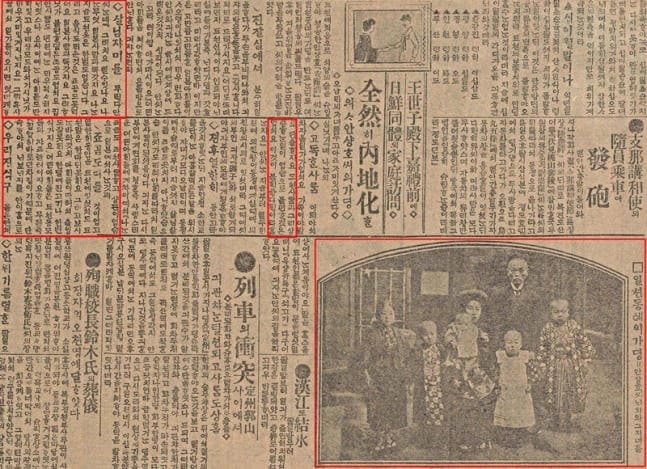
4. "We Don't Speak Korean": 1918 Media Interview Reveals 'Japanization'
An Sang-ho's lifestyle during the colonial period is further detailed in a December 10, 1918 interview with Maeil Sinbo, the official organ of the Japanese Governor-General of Korea. The article heavily promoted An, a successful doctor married to a Japanese woman, as a model family of 'Japan-Korea Assimilation' (일선동화)—a core pro-Japanese colonial ideology.
In the interview, An bragged about his complete Japanization: "I no longer wear Korean clothes and cannot eat spicy food at all. My children speak only Japanese at home and do not speak any Korean. I do not associate much with Koreans, so I feel no inconvenience." His Japanese wife, Isoko, agreed, stating, "Even after being in Korea for 11 years, I can't speak a word of Korean. Our family lives in a different world."
The National Institute of Korean History cites An Sang-ho's case as an official historical record through its 'Our History Net.' The Institute uses this article as factual evidence to demonstrate how An's family built a wall against Korean society, interacting primarily with the Japanese community and perfectly maintaining a Japanese lifestyle.
Archived Interview Bragging About Complete Assimilation! Boasting about discarding Korean clothes, language, and social ties served as official colonial propaganda endorsing Japanization.
5. Agency's "Groundless" Dismissal Criticized Ahead of Liberation Day
As the backlash mounted, Ha Young's agency, Bisters Entertainment, released an official statement on August 10. They acknowledged that the discussed figure is indeed her great-grandfather but claimed, "The rumors regarding his pro-Japanese actions are groundless." They attempted to calm the situation by adding, "As there are facts being misrepresented, we will organize the details and release another statement soon."
However, with specific historical facts such as media archives and his record as a councillor in the Daejeong Association out in the open, the agency's initial response to flatly dismiss all allegations as 'groundless' without any counter-evidence has faced harsh criticism. Observers note that their vague handling of the situation has only provoked greater public backlash.
With state archives and expert testimonies clearly existing, simply drawing a line and denying the claims seems unlikely to quell the controversy. With National Liberation Day (August 15) just days away—a time when public sentiment regarding colonial history is highly sensitive—all eyes are on whether the agency's upcoming 'detailed statement' will provide any substantive factual explanations to refute the historical records.
Unsubstantiated Denial Increases Public Mistrust! Dismissing allegations as 'groundless' without explaining documented evidence has only amplified criticism ahead of Liberation Day.
| Category / Issue | Key Facts and Historical Details |
|---|---|
| Family Relation | Actress Ha Young's great-grandfather = Physician An Sang-ho (Confirmed). |
| Medical Career | Graduated Tokyo Jikei Medical School (1902), court doctor for Emperor Gojong. |
| Gojong Poisoning Rumor | Attending doctor when Gojong died in 1919 (Not academically verified due to lack of proof). |
| Pro-Japanese Record | Listed as standing councillor for Daejeong Association (1916), backed by historical papers. |
| Media Evidence (1918) | Maeil Sinbo interview showcased his family discarding the Korean language as a model of 'Japanese assimilation.' |
| Agency Position | Claimed rumors are "groundless" (Criticized for lacking factual counter-explanation against state archives). |
[Key Summary] 5 Points on Ha Young's Great-Grandfather An Sang-ho Controversy
- 1. Variety Show Backlash: Mentioning her proud 4-generation medical family led to the revelation of her great-grandfather's identity as a royal physician.
- 2. The Unverified Poisoning Theory: Though rumored to have poisoned Gojong alongside Japanese doctors, academia requires more evidence to accept this.
- 3. Affiliation with a Pro-Japanese Group: Historical records definitively confirm An served as a councillor for the Daejeong Association, organized by notorious collaborators.
- 4. Colonial Propaganda Interview: A 1918 Governor-General newspaper article praised his family for speaking exclusively Japanese and shunning Korean culture.
- 5. Agency's Poor Crisis Response: Blanket denials without addressing documented evidence have heightened criticism as National Liberation Day approaches.
Related Tags: HaYoung, AnSangho, ProJapaneseControversy, DaejeongAssociation, MaeilSinbo, GojongPoisoning, BistersEntertainment, 2026_August_10, Japan-Korea Assimilation
728x90
반응형
그리드형(광고전용)
댓글 영역