고정 헤더 영역

상세 컨텐츠
본문 제목
President Lee Jae-myung: "Retrieval of Pro-Japanese Assets & 3 Peace Proposals to North Korea"
본문
반응형
[26.08.15] President Lee Jae-myung: "Retrieval of Pro-Japanese Assets & 3 Peace Proposals to North Korea"… Key Highlights of the 81st Liberation Day Address
On August 15, President Lee Jae-myung presented national governance visions for historical justice, honor for independence patriots, and peaceful coexistence on the Korean Peninsula at the 81st Liberation Day ceremony. Delivered at Sejong Center for the Performing Arts, this address outlined key national priorities including historical accountability, economic and social leaps, and inter-Korean and diplomatic messages, as summarized in this comprehensive overview of major state tasks.
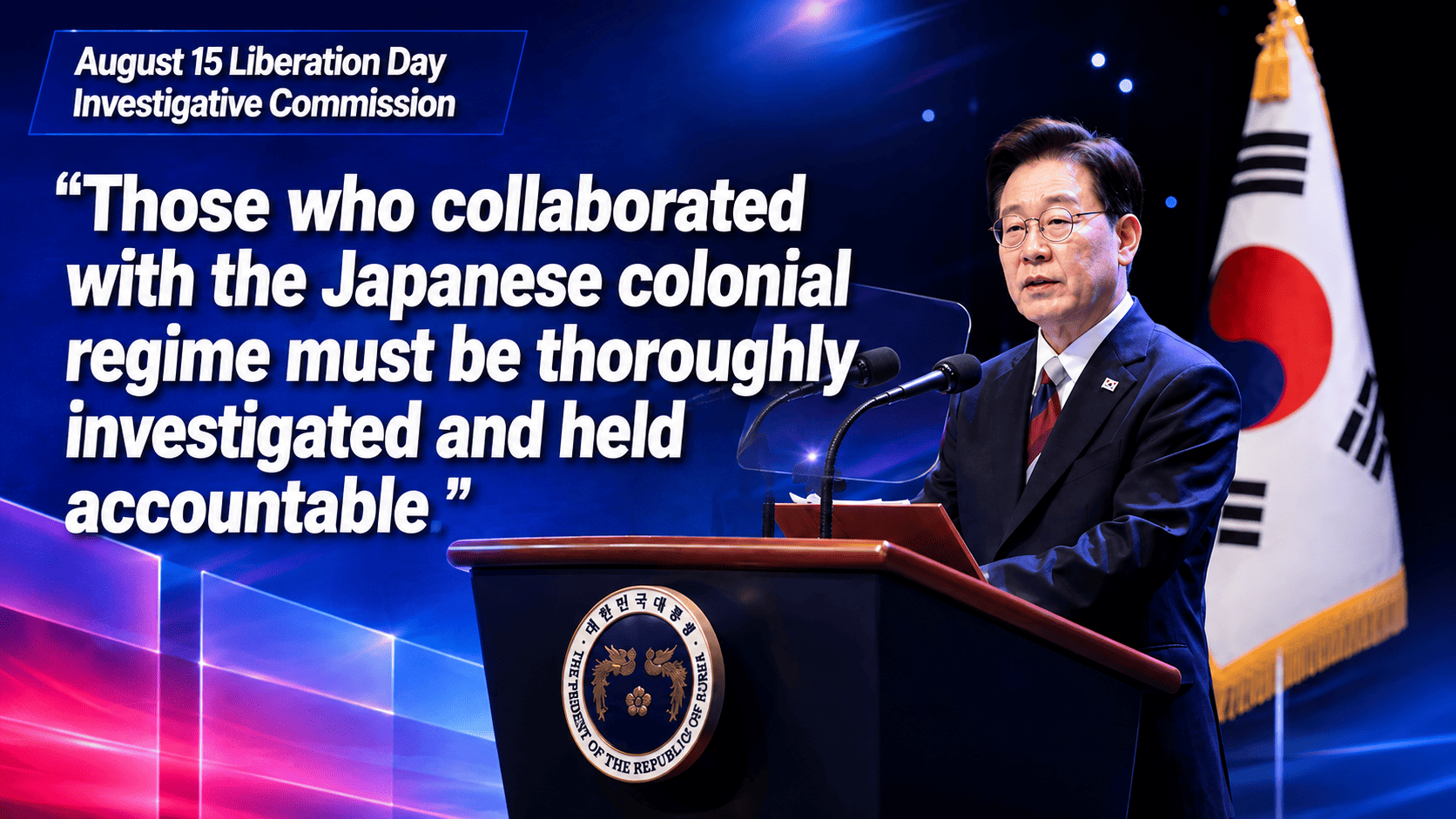
1. Realizing Historical Justice via the 'Pro-Japanese Asset Nationalization Act' & Honoring Independence Patriots
President Lee expressed a firm commitment to thoroughly investigate and retrieve assets unjustly accumulated by pro-Japanese anti-national collaborators, grounded in the 'Pro-Japanese Asset Nationalization Act' promulgated on June 2. Assets returned to the state will be strictly managed and fully utilized as financial resources to support surviving patriots, independence meritorious persons, and their bereaved families.
Furthermore, the government will expand the discovery and conferment of honors for unrewarded independence activists and actively establish commemorative facilities at home and abroad to ensure the values of the independence movement are embedded in daily life. The initiative aims to rectify historical wrongs and fully preserve the honor of those who dedicated themselves to national independence at the state level.
Legally, the 'Special Act on the Redemption of Assets of Pro-Japanese Anti-National Collaborators' explicitly stipulates that assets acquired in exchange for collaborating with Japanese imperialism shall be nationalized and used for honoring independence patriots and funding academic research. The land and assets nationalized through these retrieval procedures are transferred to the Martyrs and Independence Meritorious Persons Fund to finance statutory veterans' support programs, such as compensation payouts to bereaved families and the preservation of historical sites abroad.
Allocating retrieved pro-Japanese assets to support independence patriots… Strengthening historical accountability through state nationalization of unjustly accumulated assets and expanding discovery and honors for unrewarded independence activists.
2. Leap Toward an 'Irreplaceable Korea', Balanced Regional Development & Youth Opportunity Ladder
The address outlined national goals to transform South Korea into an 'Irreplaceable Nation' required by the world amid civilizational transitions and global geopolitical shifts. To achieve this, the President emphasized balanced national development and proactive future investments, declaring a commitment to distribute the fruits of growth evenly to citizens across all regions.
In particular, the government will build a robust opportunity ladder spanning the entire life cycle for young people entering society. Just as youth were the driving force of independence, industrialization, and democratization in the past, state support will be strengthened to ensure today's youth can overcome setbacks and emerge as tomorrow's leaders.
With over 50% of the national population currently concentrated in the Greater Seoul area and regional extinction risk indices worsening, the government has consistently pursued balanced development policies by designating Opportunity Development Zones and relocating high-tech future industry hubs. In tandem, policy financial products and social safety nets supporting housing stability and asset formation for young adults continue to expand social mobility and opportunity access.
Establishing growth hubs across the nation and building a youth opportunity ladder… Creating sustainable hope accessible to all through expanded future investment and balanced regional growth.
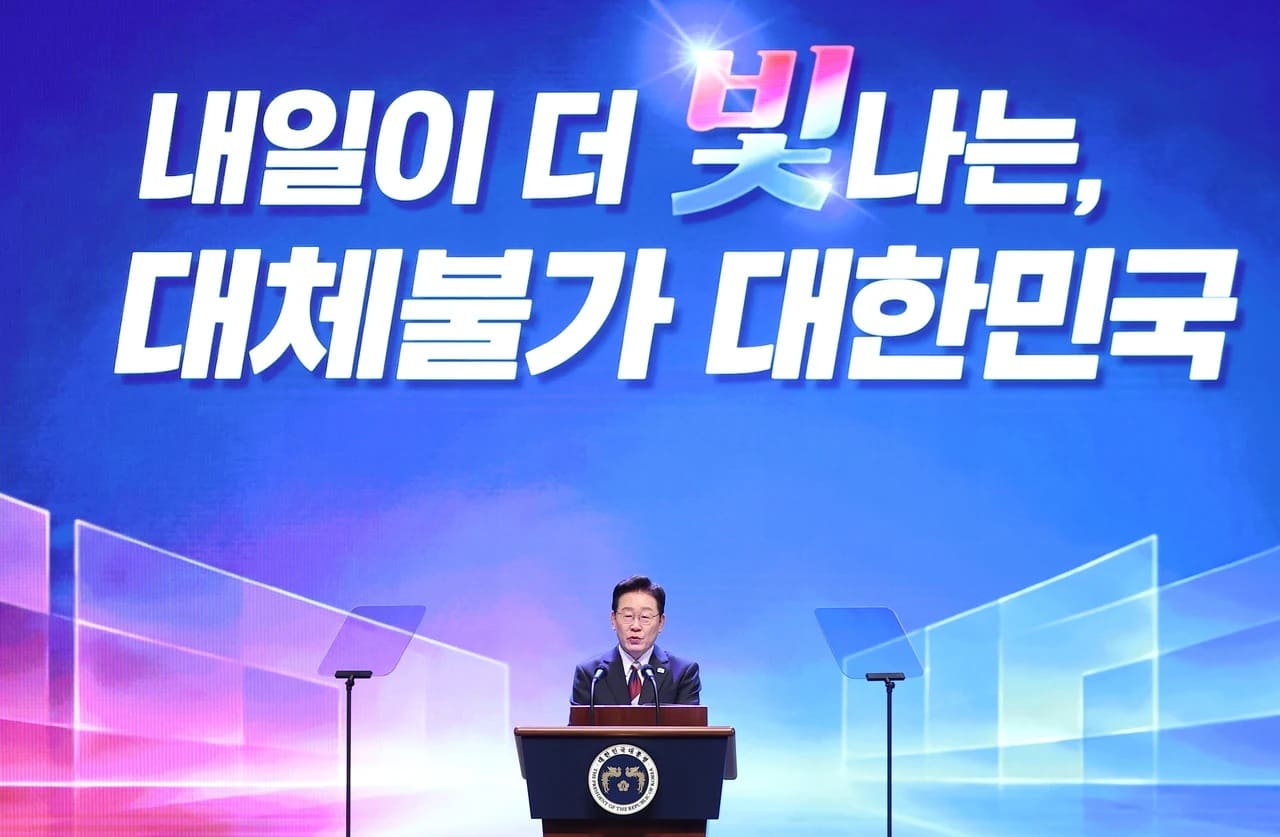
3. 'Three Peace Proposals' for Korean Peninsula Coexistence & Seeking Transition of the Armistice System
Addressing North Korea, President Lee officially announced three peace proposals: ▲Inclusive Peaceful Coexistence, ▲Stable Peaceful Coexistence where conflict is unnecessary, and ▲Responsible Peaceful Coexistence contributing to world peace. He urged mutual respect for political systems, reduction of hostility, cessation of unnecessary confrontation, and participation in dialogue for shared growth.
He also proposed establishing multi-layered safeguards to prevent crisis escalation on the Korean Peninsula and initiating discussions among involved parties to transition the current armistice system into a permanent peace regime. Through this peacebuilding process, effective measures to halt the advancement of North Korea's nuclear capabilities can also be jointly discussed.
The Korean Armistice Agreement signed in 1953 represents a temporary cessation of hostilities rather than a permanent peace; thus, transitioning it into a legal and institutional peace treaty framework has been a central agenda in past inter-Korean agreements, including the 1991 Inter-Korean Basic Agreement. The practical demilitarization of the Demilitarized Zone (DMZ) into a peace zone and the maintenance of multilateral security consultative mechanisms are recognized as crucial mechanisms for mitigating the inherent instability of the armistice regime.
3 Peace Coexistence Proposals & transition from armistice to peace regime… Promoting practical discussions to halt North Korean nuclear advancement through mutual de-escalation and proactive peace measures.
4. Inheriting the Spirit of the Kim Dae-jung–Obuchi Declaration & Building Future-Oriented Korea-Japan Relations
In diplomacy, the President highlighted the importance of future-oriented Korea-Japan relations grounded in pragmatic national interest. Reaching out to victims and bereaved families carrying past wounds, he emphasized that warmth must reach those living in the shadow of history.
As demonstrated by the '1998 Kim Dae-jung–Obuchi Joint Declaration', he stressed that solid mutual trust must be built upon the courage and sincerity to face history squarely. Korea plans to foster a collaborative relationship addressing common challenges while maintaining an accurate memory of past history.
The 'Japan-South Korea Joint Declaration of 1998 (Kim Dae-jung–Obuchi Declaration)' was a milestone achievement in which Japan explicitly expressed deep remorse and heartfelt apology for its colonial rule, and both nations agreed to build a future-oriented partnership. This declaration serves as a foundational reference for bilateral diplomatic policy, enabling both countries to advance cooperation in economic, cultural, human exchange, and supply chain security domains while maintaining historical truth.
Pragmatic diplomacy based on facing history squarely and extending warmth to victims… Expanding mutual trust and joint cooperation by inheriting the sincerity of the Kim Dae-jung–Obuchi Declaration.
5. 'One Team' Cooperation among Citizens, Businesses, and Labor & Presenting the Four Visions of Liberation
Social compromise and national integration were highlighted as the core engines driving state policies. The message urged citizens, the government, central and local authorities, enterprises, and workers to unite as 'One Team' to navigate fierce global competition.
Finally, President Lee presented the 'Four Visions of Liberation' consisting of ▲Liberation of Hope, ▲Liberation of Opportunity, ▲Liberation of Balance, and ▲Liberation of Peace, concluding the address with a pledge to write a new chapter of history through politics of compromise and coexistence that transcend differences in thought and interest.
Amid rapid industrial transformations including global supply chain realignments and digital/green transitions, social compromise and the role of tripartite dialogue bodies (such as the Economic, Social & Labor Council) are pivotal factors in maintaining national competitiveness. Establishing a nationwide collaborative framework that balances labor market flexicurity with robust social safety nets serves as an essential foundation for overcoming economic challenges and preventing social division.
Declaration of grand social compromise and the Four Visions of Liberation… Pursuing state administration based on compromise and coexistence toward the goals of hope, opportunity, balance, and peace.
| Key Category | Core National Policy Deliverables |
|---|---|
| 1. Historical Justice & Patriots' Honor | Investigation and retrieval under the Pro-Japanese Asset Nationalization Act, allocation of nationalized funds to support bereaved families, and expanded discovery of unrewarded independence activists. |
| 2. National Vision & Youth Support | Leap to an Irreplaceable Nation, turning the entire territory into growth hubs, and establishing a youth life-cycle opportunity ladder. |
| 3. Inter-Korean Policy & Peace | 3 Peace Coexistence proposals (Inclusive, Stable, Responsible), transition of armistice to peace regime, and discussions to halt North Korean nuclear advancement. |
| 4. Korea-Japan Relations & Diplomacy | Inheriting the spirit of the 1998 Kim Dae-jung–Obuchi Declaration, pragmatic diplomacy rooted in facing history, and honoring victims. |
| 5. National Unity & 4 Liberations | Building a 'One Team' structure across government, industry, and labor, achieving the 4 Liberation visions (Hope, Opportunity, Balance, Peace). |
[Summary] 5 Key Highlights of the 81st Liberation Day Address
- 1. Pro-Japanese Asset Retrieval & Patriots' Honor: Unjustly accumulated assets will be nationalized under the Pro-Japanese Asset Nationalization Act to fully support bereaved families and honor unrewarded independence activists.
- 2. Irreplaceable Korea & Balanced Growth: Transforming the entire national territory into regional growth hubs and creating an opportunity ladder for young people to boost economic potential.
- 3. Three Proposals for Peace Coexistence: Mitigating inter-Korean hostility and transitioning the armistice system into a permanent peace regime to find practical solutions to the North Korean nuclear issue.
- 4. Future-Oriented Korea-Japan Relations: Inheriting the spirit of the Kim Dae-jung–Obuchi Declaration to face history squarely, comfort victims, and conduct pragmatic national-interest diplomacy.
- 5. National Integration & Four Liberations: Realizing the visions of hope, opportunity, balance, and peace through politics of coexistence that respect differences.
Related Tags: Lee Jae-myung, Liberation Day, Presidential Address, Pro-Japanese Asset Nationalization Act, Independence Patriots, Irreplaceable Korea, Korean Peninsula Peace, Korea-Japan Relations, Kim Dae-jung Obuchi Declaration, National Integration
728x90
반응형
그리드형(광고전용)
댓글 영역