고정 헤더 영역

상세 컨텐츠
본문 제목
500 mm Water Bomb Hits Geoje in 6 Hours… Landslide Kills 1, Damage Escalates Regionwide
본문
반응형
[26.08.17] 500 mm Water Bomb Hits Geoje in 6 Hours… Landslide Kills 1, Damage Escalates Regionwide
Record-breaking heavy rain poured over coastal areas of South Gyeongsang Province, including Geoje and Tongyeong, during the Liberation Day holiday, triggering landslides, flooding, and washed-out roads. Notably in Geoje, an extreme torrential downpour of over 500 mm concentrated in just 6 hours between midnight and 6:00 AM on August 17, leading to casualties as earth and debris buried the lower floors of an apartment building.
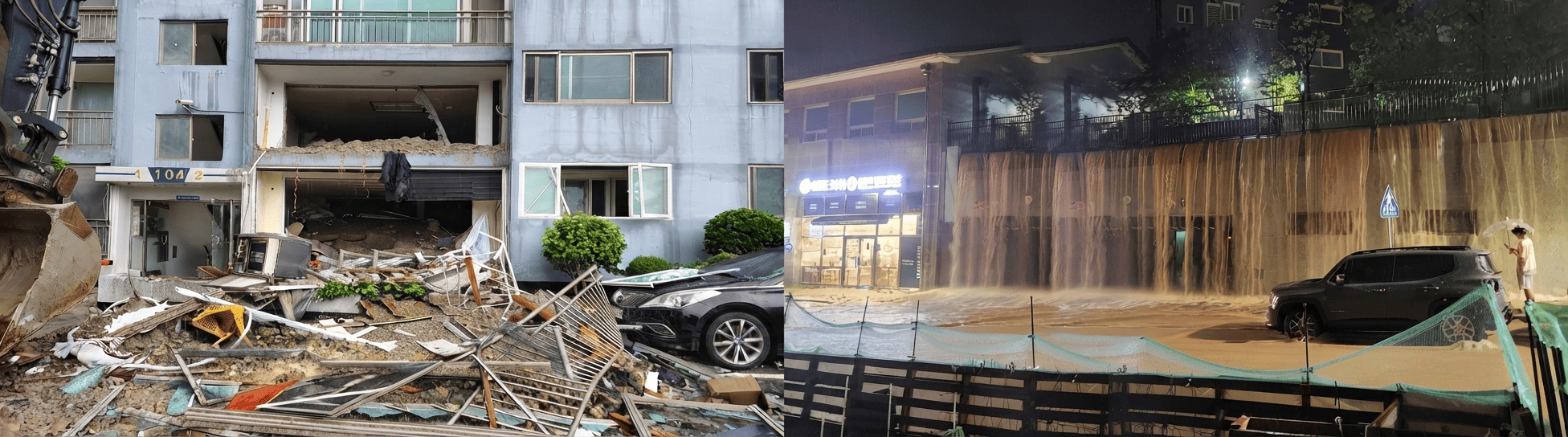
1. 508.8 mm in 6 Hours in Geoje… Landslide Causes 1 Fatality
According to the Korea Meteorological Administration (KMA) and South Gyeongsang Provincial Government, record-breaking torrential rains hit Geoje, South Gyeongsang Province, from August 15, the start of the Liberation Day holiday, through August 17. In particular, 508.8 mm of rain poured down between midnight and 6:00 AM on August 17 alone. Cumulative rainfall at the Hadun station reached 843.5 mm.
The intense downpour concentrated over a short period led to human casualties. Around 4:42 AM on August 17, a landslide occurred near an apartment complex in Okpo-dong, Geoje-si, where mud and debris cascading down the mountain struck the first floor of the building. This accident resulted in casualties, with a man in his 20s losing his life and a woman in her 50s being transported to a hospital with a left arm fracture.
It was identified that a total of 8 households—4 on the 1st floor and 4 on the 2nd floor—were buried in earth and soil. Damage escalated as mud pouring from the mountain swept through the passageway between apartment buildings. Currently, all residents from the 2 affected building blocks of the apartment complex have been evacuated.
At the scene, soil continues to slide down from the mountain, raising high concerns over secondary landslides. Fears are being raised that an additional collapse could potentially bury up to the 4th and 5th floors of the apartment building.
The rainfall intensity in the Geoje region at the time went beyond simply having high cumulative numbers. By 2:32 AM on August 17, Geoje recorded 124.5 mm of rainfall in a single hour, an intensity analyzed in provided data as a once-in-200-years event for the area. The concentration of 508.8 mm within 6 hours from midnight to 6:00 AM triggered a series of soil runoffs and facility damages, particularly around landslide-prone hazard zones.
A landslide in Okpo-dong, Geoje, buried lower floors of an apartment building under earth and debris. Record-breaking rainfall concentrated in a short period led to actual casualties, heightening tensions over potential secondary landslides.
2. Flooding and Infrastructure Damage Across Geoje & Tongyeong… Hundreds Evacuated
Landslides occurred in Deokpo-dong and Sangdong-dong, Geoje, while water supply pipes were ruptured in Geoje-myeon and Dundeok-myeon. Geoje-si notified residents that water outages could persist in certain areas through August 18 due to the damaged supply mains.
In Sadeung-myeon, a bridge destroyed by fierce currents was damaged, and in locations like Geoje Hoejin Village, rescue operations were conducted for residents stranded by floodwaters. In Yesol Village, Aju-dong, about 100 residents urgently evacuated as landslide risks escalated.
In an apartment building in Yangjeong-dong, an elevator trapping incident occurred, but 3 occupants managed to escape safely on their own. Traffic disruptions continued across major roads, tunnels, and underpasses in the Geoje area due to closures from flooding and mudslide debris.
As of 4:00 PM on August 17, a total of 365 displaced persons from 225 households were reported across Geoje and Tongyeong. Among them, 240 individuals from 139 households remain unable to return home, staying in temporary shelters and designated facilities.
According to South Gyeongsang Province statistics, a total of 165 people from 125 households were evacuated to safe places across 3 cities and counties, including Tongyeong, Sacheon, and Geoje. While 66 people from 45 households have returned home, 99 people from 80 households remain away from home, sheltering at community centers, village halls, or relatives' homes. Preemptive local evacuations continued, including the urgent evacuation of over 100 residents from Yesol Village, Aju-dong, Geoje, where landslide hazards spiked.
Heavy rain damage was not limited to landslides. Widespread damage across residential homes, roads, bridges, water supply, and electrical infrastructure severely disrupted residents' daily lives.

3. Over 200 Locations Restricted in South Gyeongsang… Damage Concentrated in Geoje and Tongyeong
According to the South Gyeongsang Disaster and Safety Countermeasures Headquarters, heavy rain damage mounted across the province starting on the morning of August 17. Due to rains continuing since August 15, the average cumulative rainfall across South Gyeongsang Province reached 195.9 mm, with heavy precipitation heavily concentrated along the southern coast in Geoje and Tongyeong.
By city and county, Geoje-si recorded the highest cumulative rainfall at 570.3 mm, followed by Tongyeong-si (449.2 mm), Goseong-gun (327.9 mm), and Sacheon-si (286.7 mm). By observation station, extreme rainfall was recorded at Hadun in Geoje (843.5 mm) and Tongyeong station (684.9 mm).
The scale of damage continues to grow. 12 road sections, 4 river sites, 23 landslide sites, and 20 residential houses were damaged or flooded, while 2,030 households experienced inconvenience due to power outages. Livestock losses were also reported, with 2 animals dead.
Traffic and entry were restricted at 212 locations across the province due to rising river levels and flooding risks. Controlled locations included 111 low-water bridges (Sewol bridges), 47 riverside trails, 18 riverbed roads, 13 general roads, and 2 riverside parking lots.
In Geoje, key transportation routes and surrounding areas—including the Oryang Interchange ramp section, Aju Tunnel, and Jangpyeong Underpass, as well as the area near the intercity bus terminal—were blocked to traffic due to flooding and soil runoff.
Fire services carried out large-scale rescue and safety measures. According to provided data, the South Gyeongsang Fire Department rescued 132 individuals and conducted 1,461 safety response operations. Earlier action tallies included 32 rescue missions and 6 water pumping support actions, as resident rescues, drainage support, and safety measures in high-risk zones proceeded concurrently during the rainstorm.
Widespread traffic restrictions remain in effect due to rain concentrated on the southern coast of South Gyeongsang. Geoje and Tongyeong in particular see concentrated disaster responses as landslides, flooding, and infrastructure damages struck simultaneously.
4. 100 mm/h Extreme Rainfall Realized… 'New Normal' Concerns From Climate Change
Particularly noteworthy in this downpour is the amount of rainfall concentrated in extremely short timeframes. Early on August 17, Geoje recorded 124.5 mm of rain in a single hour. This intensity is analyzed as a roughly 1-in-200-year event, while Tongyeong recorded 97.4 mm in one hour, matching a 1-in-100-year event level.
Extreme heavy rain around 100 mm per hour has been recurring in recent years. In September 2024, Jindo, South Jeolla Province recorded 112.2 mm per hour; in July 2025, Seosan, South Chungcheong Province recorded 114.9 mm; and in September of the same year, Gunsan, North Jeolla Province recorded 152.2 mm per hour, showing that torrential downpours once considered anomalous are now occurring repeatedly.
As climate change progresses, rainfall patterns are likely to shift further. As temperatures rise, the atmosphere's capacity to hold moisture increases, meaning that while rainy days may decrease overall, the volume and intensity of individual rainfall events will escalate.
The Intergovernmental Panel on Climate Change (IPCC) Sixth Assessment Report analyzed that for every 1°C increase in global average temperature, heavy precipitation intensity could increase by approximately 7%. KMA analysis also showed that from 1912 to 2024 in South Korea, annual rainy days decreased by 0.68 days per decade, whereas annual precipitation increased by 17.83 mm per decade.
As heavy rain intensity escalates, the scale of damage increases exponentially. Rainfall of around 50 mm per hour can already cause road flooding and difficulty in walking; exceeding 100 mm per hour can submerge vehicles, flood lower levels of buildings and facilities, and significantly increase the risk of landslides due to weakened ground.
Taking this heavy rain as a turning point, emergency disaster text alert systems for extreme rainfall are gaining attention. According to provided data, since 2023, the KMA has been directly issuing 'Heavy Rain Emergency Disaster Texts' when conditions such as 72 mm in 1 hour or 50 mm in 1 hour combined with 90 mm over 3 hours are expected. Starting this year, 'Disaster Heavy Rain Emergency Disaster Texts' are additionally dispatched when rainfall exceeding 100 mm in 1 hour (or 85 mm in 1 hour + 25 mm in 15 minutes) is forecasted. During this event, related emergency alerts were sent out to Geoje, Tongyeong, and Gadeokdo in Busan.
With extreme rainfall exceeding 100 mm/h recurring, the nature of weather disasters is shifting. Because heavy rain concentrates over narrow areas in short spans of time, securing the 'golden time' for predictions and evacuations is becoming increasingly vital.
5. 41 Schools Damaged… Power and Water Restoration and Further Evacuations Continue
Educational facilities also suffered successive damage from the downpour. As of 4:00 PM on August 17, a total of 41 heavy rain damage reports involving educational facilities—including kindergartens, elementary, middle, and high schools—were received by the South Gyeongsang Provincial Office of Education. By region, 33 were in Geoje and 8 in Tongyeong; no human casualties were reported at school facilities.
Geoje Jeil High School suffered classroom water leakage, while Dundeok Middle School experienced flooding in its gymnasium and library, prompting a decision to temporarily close school on August 18. Remaining schools also adjusted their academic schedules considering childcare needs, with the possibility of additional school closures depending on damage assessments.
Damage to water supply and power facilities continued as well. Geoje-si announced that water outages were expected through the afternoon of August 18 due to broken water mains in Geoje-myeon and Dundeok-myeon. Two broken main points were confirmed in Dundeok-myeon, while the exact extent of damage in Geoje-myeon is still under investigation.
Power outages also occurred. According to KEPCO's South Gyeongsang branch, power was cut to approximately 2,100 households in the Geoje area, with restoration completed for about 1,200 households. Restoration work continued for around 800 households in Yeoncho-myeon and Mondong-dong. In an apartment complex in Suyang-dong, a large-scale power outage was reported after its internal electrical room was submerged.
South Gyeongsang Province upgraded its Disaster and Safety Countermeasures Headquarters emergency status to Level 2 and mobilized 1,468 provincial, city, and county officials into a 24-hour emergency response system. Personnel and equipment were forward-deployed to landslide risk zones, steep slopes, riverbanks, and underpasses, while safety management for vulnerable groups was strengthened.
Power and water supply disruptions remained factors directly impacting residents' daily lives even after the heavy rain passed. In Geoje, 2 water main breaks occurred in Dundeok-myeon and further damage was confirmed in Geoje-myeon, leading to water outage notices in some areas through August 18. Regarding electrical utilities, out of roughly 2,100 blacked-out households, about 1,200 were restored while recovery work continued in areas such as Yeoncho-myeon and Mondong-dong.
Risks of landslides, flooding, and structural collapses linger even after rain stops. Authorities strongly urge the public to avoid valleys and rivers, and to evacuate immediately from areas at risk of landslides or rockfalls to prevent secondary casualties.
| Category | Details and Current Status |
|---|---|
| Geoje Extreme Rainfall | 508.8 mm recorded from 0:00 to 6:00 AM on Aug 17; Hadun cumulative 843.5 mm |
| Hourly Rainfall Intensity | Geoje 124.5 mm/h, Tongyeong 97.4 mm/h severe hourly records |
| Casualties | 1 dead in Geoje apartment landslide; injuries reported in Geoje & Tongyeong |
| Displaced Persons | 365 persons from 225 households displaced as of 4:00 PM Aug 17; 240 persons (139 households) still unreturned |
| Major Infrastructure Damage | Widespread damage to roads, rivers, landslides, housing, water mains, and power facilities |
| Traffic Control Status | 212 locations controlled province-wide including riversides, Sewol bridges, riverbed roads, and underpasses |
| Educational Facility Damage | Total 41 educational facilities damaged (33 in Geoje, 8 in Tongyeong) |
| Power Outages | Approx. 2,100 households lost power in Geoje; ongoing restoration efforts in select areas |
| Disaster Response | South Gyeongsang Province upgraded to Level 2 emergency; 1,468 officials on 24-hour emergency duty |
5 Key Facts on Geoje & South Gyeongsang Extreme Heavy Rain
- 1. 500 mm Downpour in 6 Hours: 508.8 mm of rain concentrated in Geoje between 0:00 and 6:00 AM on August 17, bringing cumulative rainfall at Hadun to 843.5 mm.
- 2. Landslide Casualties: A landslide in Okpo-dong, Geoje, buried lower apartment floors, leaving 1 person dead and causing additional injuries.
- 3. Widespread Flooding & Infrastructure Damage: Roads, rivers, homes, bridges, water supply mains, and power lines sustained damage, leading to traffic controls across 212 locations in the province.
- 4. Impact on Schools & Utilities: 41 educational facilities in Geoje and Tongyeong suffered water damage leading to school closures; water outages and power blackouts affected parts of Geoje.
- 5. Enhanced Extreme Rain Response: Amid recurring downpours exceeding 100 mm/h, South Gyeongsang Province raised its emergency status to Level 2 and deployed extensive personnel and resources to prevent secondary disasters.
Related Tags: Geoje Heavy Rain, Geoje Torrential Rain, Geoje Landslide, Tongyeong Heavy Rain, South Gyeongsang Heavy Rain, Extreme Heavy Rain, Geoje Flooding, South Gyeongsang Landslide, 100mm Per Hour, Disaster Heavy Rain, Climate Change, Heavy Precipitation
728x90
반응형
그리드형(광고전용)
댓글 영역