고정 헤더 영역

상세 컨텐츠
본문 제목
[26.01.07] Landfill Ban Sends Seoul’s Waste to Regions, Sparking Environmental Inequality Debate
본문
반응형
Seoul’s Trash Reaches Chungcheong Province as Landfill Ban Backlash Becomes Reality
📍Waste Shifted to Non-Metropolitan Private Incinerators Amid Capacity Limits, Raising “Trash Colony” Concerns
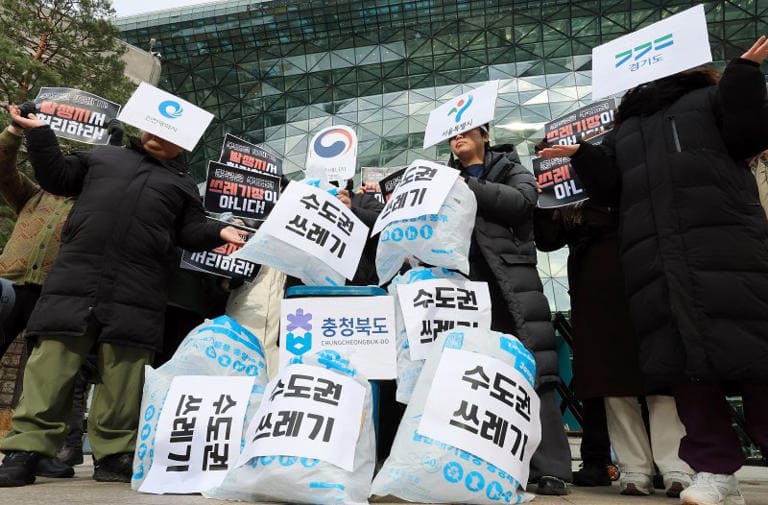
As the ban on direct landfill disposal of household waste takes effect, Seoul’s district governments are turning to private waste disposal companies in non-metropolitan regions such as Chungcheong Province after failing to secure alternatives. The large-scale transfer of metropolitan waste to regional areas is fueling concerns over environmental inequality and public health risks.
🔹 Landfill Ban Forces Seoul’s Waste to Chungcheong Region
With direct landfill disposal of household waste now prohibited, several Seoul districts have confirmed plans to outsource waste treatment to private companies located in Chungcheong Province, including Gongju, Seosan, and Buyeo. Concerns over a “trash crisis” in the metropolitan area are becoming a reality.
Geumcheon District in Seoul signed contracts last month with three private waste treatment companies located in Gongju and Seosan in South Chungcheong Province and Hwaseong in Gyeonggi Province, beginning waste processing on the 1st of this month. The district plans to distribute and process an average of 80 tons of household waste per day among these facilities.
🔹 Metropolitan Landfill Halt Leaves Limited Options
Until last year, Geumcheon District disposed of its waste at the Sudokwon Landfill in Incheon. However, following the implementation of the landfill ban, the district was forced to seek alternatives such as incineration or recycling. Attempts to use the Yangcheon Resource Recovery Facility failed due to opposition from local residents.
A Geumcheon District official stated, “It is extremely difficult to find suitable waste treatment facilities near Seoul,” adding, “With both landfill and incineration options restricted, this was an unavoidable decision.”
🔹 Jung District Also Turns to Private Facility in North Chungcheong
Jung District in central Seoul has also signed a contract with a private household waste processing company in Eumseong County, North Chungcheong Province. The district generates approximately 110 tons of waste daily, part of which was previously incinerated at the Mapo Resource Recovery Facility, with the remainder sent to landfills.
A Jung District official said, “Although private facilities are more expensive than public incinerators, the selected company offered the lowest bid through a competitive bidding process.”
🔹 Seoul Incineration Facilities at Capacity
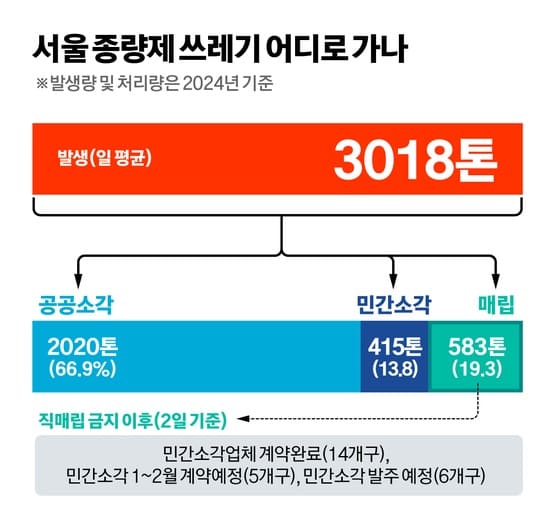
Seoul currently operates four major resource recovery facilities in Mapo, Yangcheon, Nowon, and Gangnam, processing approximately 2,200 tons of waste per day. However, aging infrastructure and limited capacity have forced continued reliance on landfills and private contractors.
With the landfill ban now in effect, additional waste previously sent to landfills must be incinerated or outsourced, further increasing the burden on the system.
🔹 Majority of Districts Contract Private Firms
According to the Public Procurement Service’s bidding platform, as of the 31st of last month, 14 of Seoul’s 25 districts had completed contracts with private waste treatment companies. Jungnang, Jongno, Eunpyeong, and Gangseo districts are expected to finalize contracts by next month, while Gwangjin, Dobong, Nowon, Seodaemun, and Yangcheon districts are currently in the bidding process. Guro District is exempt due to a special landfill allowance.
🔹 “Metropolitan Waste Should Be Handled in the Metropolitan Area”
Residents in non-metropolitan regions have voiced strong opposition. Yoo Min-chae, a resident of Bukimyeon in Cheongju, North Chungcheong Province, said, “If waste is sent here simply because there is nowhere else to burn it, the damage is borne entirely by local residents. Metropolitan waste should be handled within the metropolitan area.”
🔹 Growing Concerns Over “Trash Colony” Structure
In 2021, the government revised enforcement rules under the Waste Management Act, banning direct landfill disposal of household waste in the metropolitan area starting in 2026 and nationwide from 2030. The metropolitan region was given a five-year grace period to expand alternative facilities such as incinerators, but preparations have been insufficient, critics say.
As a result, metropolitan governments have begun shipping waste to non-metropolitan regions with high concentrations of private incinerators, increasing the burden on communities already handling industrial waste.
🔹 Health Risks and Environmental Inequality
In Bukimyeon, Cheongju, where an incinerator processes 353 tons of waste daily, 105 out of approximately 6,000 residents were diagnosed with lung cancer between 2001 and 2016, a rate 35 percent higher than the national average. Residents report dust pollution and unexplained health issues following facility expansions.
🔹 Solutions: Local Treatment and Waste Reduction
Experts emphasize the need for policy reform grounded in environmental justice. Ko Jeong-geun, head of the public interest research institute BlueDot, said, “Policies that force sacrifice on certain regions are not sustainable,” adding that public incineration facilities must be expanded in line with the principle of local waste treatment.
Hong Soo-yeol, director of the Resource Circulation Economy Research Institute, stressed that “the core goal of the landfill ban is waste reduction and expanded recycling,” calling for investment in preprocessing infrastructure and stricter corporate regulations to reduce waste generation overall.

One-line summary : Following the landfill ban, Seoul’s waste is being sent to non-metropolitan regions, raising concerns over environmental inequality and public health risks.
728x90
반응형
그리드형(광고전용)
댓글 영역