고정 헤더 영역

상세 컨텐츠
본문 제목
[26.01.08] Muan Airport Crash Probe Points to Concrete Structure as Key Factor
본문
반응형
Muan Airport Tragedy: All Passengers Might Have Survived Without Concrete Mound
📍Report Submitted to National Assembly Indicates Localizer Structure Amplified Damage
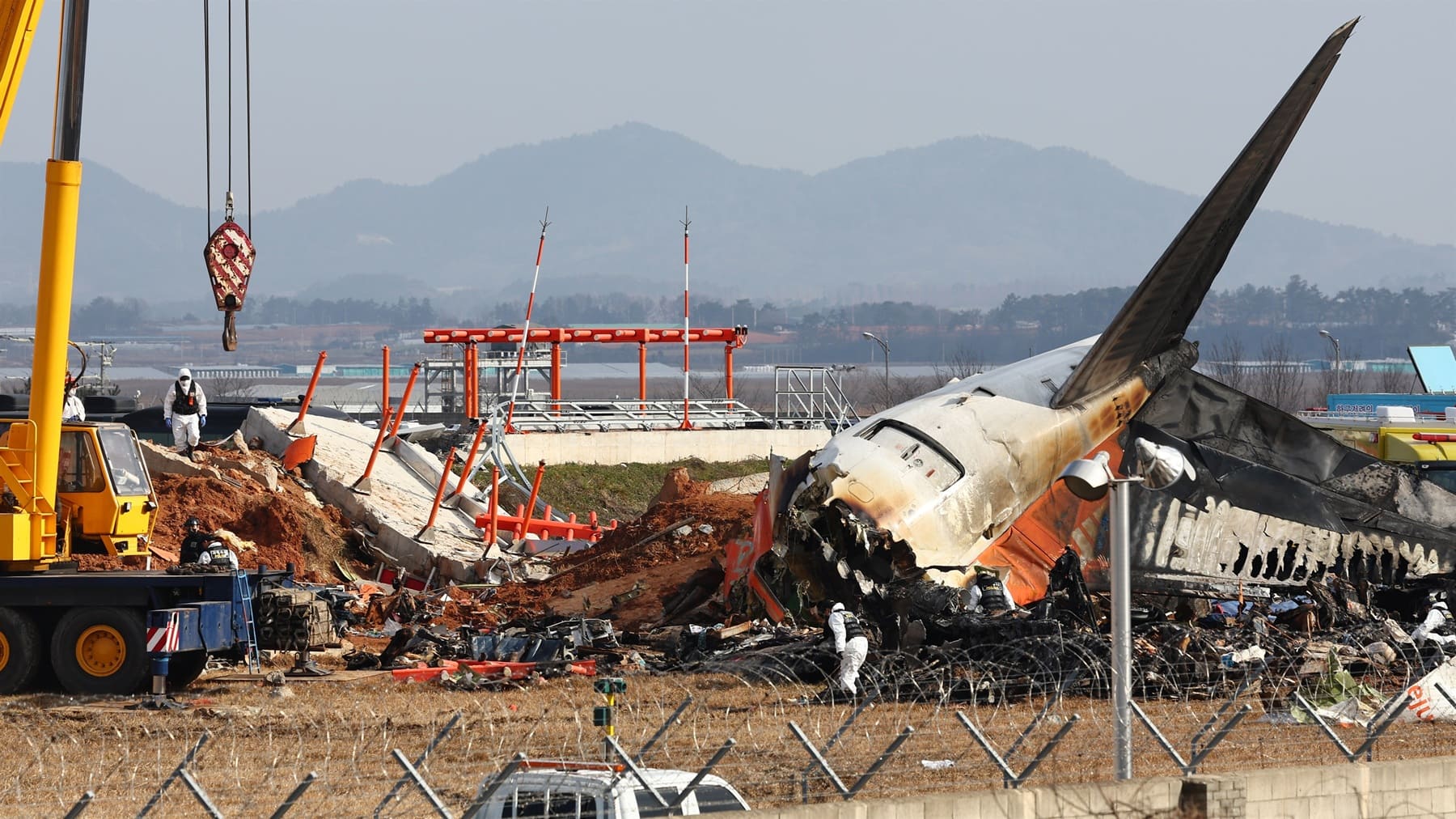
A new analysis has found that all passengers might have survived without serious injuries if the concrete localizer mound at the crash site had not existed in the Jeju Air passenger plane disaster at Muan International Airport last December. The findings contradict the government’s long-held position that no safety regulations were violated.

🔹 Simulation Results Submitted to National Assembly
According to Kim Eun-hye, a lawmaker from the People Power Party and opposition secretary of the National Assembly’s special investigation committee into the Dec. 29 air disaster, the simulation results were included in a research report submitted by the Aviation and Railway Accident Investigation Board (ARAIB) under the Ministry of Land, Infrastructure and Transport (MOLIT).
In March last year, ARAIB commissioned the Korean Society of Computational Structural Engineering to analyze how the localizer mound at the end of Muan Airport’s runway affected the scale of damage. The research team used a supercomputer to virtually model the aircraft, runway, and airport facilities and conducted detailed collision simulations.
🔹 “Aircraft Would Have Stopped After Sliding”
The analysis showed that if the aircraft had not collided with the concrete mound, it likely would have slid approximately 770 meters along the runway after belly landing before coming to a stop. In such a scenario, no fatal impact to passengers would have occurred.
Even if the localizer mound had been built with a frangible, breakable structure instead of concrete, the outcome would have been similar. While the aircraft might have crossed the airport perimeter fence and veered into nearby farmland, the likelihood of serious injuries would have been low.
🔹 Concrete Structure Identified as Damage Amplifier
Although the findings do not constitute a final investigative conclusion, they support long-standing claims by aviation experts that the concrete mound significantly amplified the severity of the accident.
Documents disclosed by Rep. Kim show that MOLIT recently acknowledged in a written response to the National Assembly that “the localizer facility at Muan Airport did not comply with airport safety operation standards.” Under regulations, structures located within 240 meters of the runway threshold for precision approaches should have been designed with frangible materials.
🔹 First Official Admission by MOLIT
Immediately after the accident, MOLIT maintained that the concrete mound did not violate any laws. While then-Minister Park Sang-woo later expressed regret over regulatory interpretation, this marks the first time the ministry has explicitly acknowledged noncompliance.
Localizer safety standards were established in 2003 and have applied to Muan Airport since its opening in 2010. Critics note that these standards were still in effect during the localizer renovation works conducted between 2020 and early 2024, indicating that corrective measures should have been taken.
🔹 “Design Review Omitted, Oversight Failed”
Rep. Kim argued that while the initial design bid included a review of frangible structure options, such considerations were omitted in later reporting stages. She criticized both MOLIT and the Korea Airports Corporation for accepting the design without raising objections, citing poor oversight.
“With analysis now showing that everyone could have survived without the mound, the government’s previous explanations have lost credibility,” Kim said, calling for accountability throughout the entire process from design to renovation and maintenance.
🔹 Bereaved Families: “Not an Inevitable Accident”
The association of bereaved families from the Dec. 29 Jeju Air disaster also released a statement, asserting that the report scientifically demonstrates the tragedy was not an unavoidable accident.
They stated that the conclusion that all passengers would have survived without the concrete mound was not hypothetical, but based on supercomputer collision simulations and seat-by-seat impact analysis.
🔹 “Findings Suppressed, Truth Must Be Revealed”
The families criticized the fact that the research findings were not disclosed despite repeated public requests. They accused ARAIB and the police of blocking access to the study throughout its process and ignoring the families’ demands, calling it a deceptive act.
They further argued that since the project was commissioned by MOLIT through a private contract, the agency responsible for the accident effectively controlled and concealed the investigation results.
The families demanded clear answers as to why the mound existed, why it was not corrected during the 2020 renovation, and why the truth was hidden for over a year, vowing to pursue accountability for the 179 lives lost.

One-line summary : Analysis shows the Jeju Air crash at Muan Airport could have seen all passengers survive if the concrete mound had not amplified the impact.
728x90
반응형
그리드형(광고전용)
댓글 영역