고정 헤더 영역

상세 컨텐츠
본문 제목
[26.04.27] Sawe Breaks Marathon’s Two-Hour Barrier for the First Time…1:59:30
본문
반응형
Marathon’s Two-Hour Barrier Falls: Sawe Achieves First Official Sub-2 in London
📍1:59:30 World Record; Kejelcha Also Breaks Barrier as ‘Super Shoes, Science, and Conditions’ Combine
The long-standing “two-hour barrier,” considered the final taboo in men’s marathon, has finally been broken in an official race. Kenya’s Sebastian Sawe recorded 1:59:30 at the London Marathon, becoming the first athlete in history to achieve a sub-two-hour finish under officially sanctioned race conditions. This achievement is regarded as a symbolic moment in which a boundary long believed to represent the limits of human capability has been overcome in a real competitive environment.

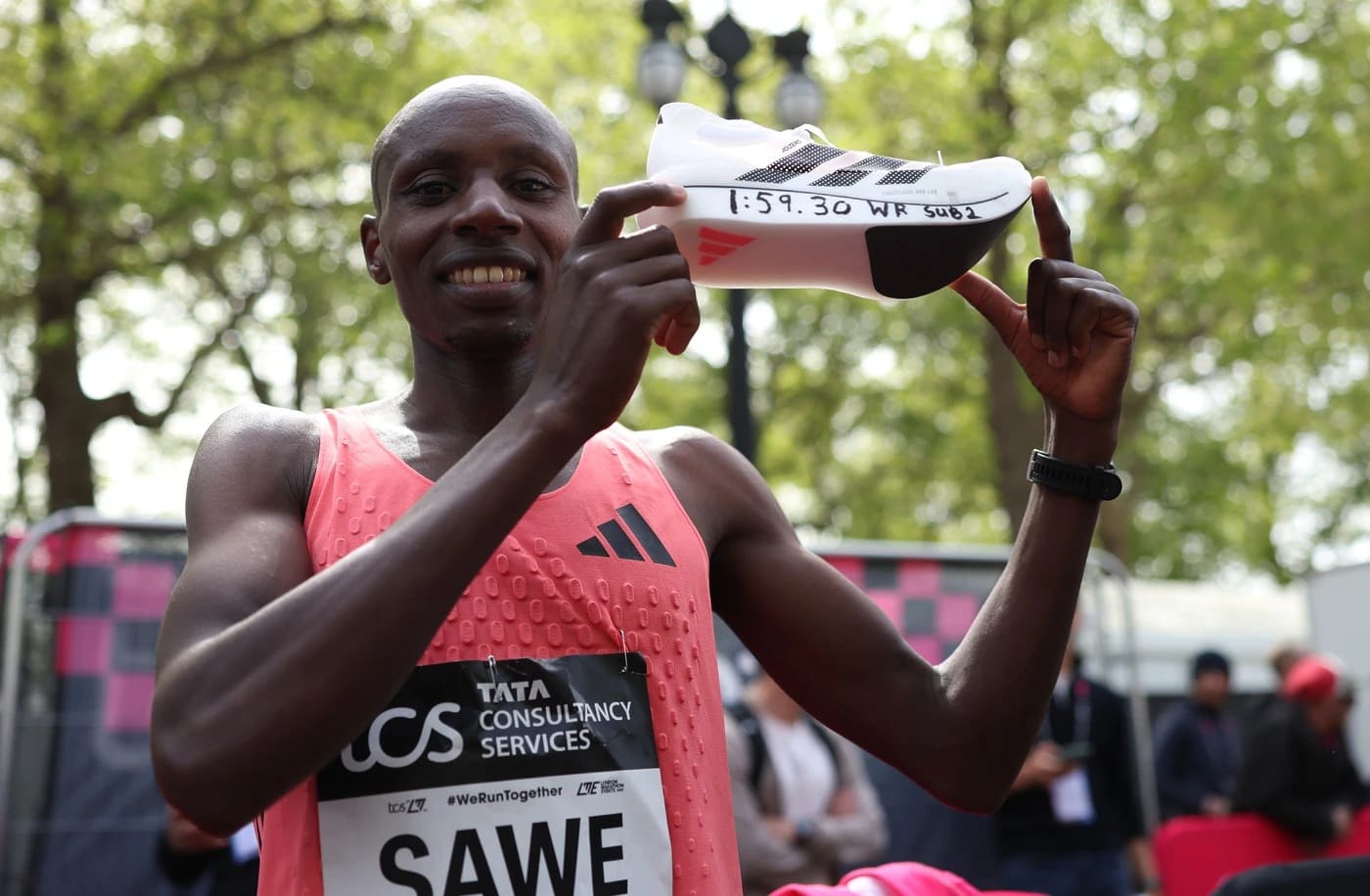
🔹 The Sub-2 Barrier, a Human Limit, Falls on the Official Stage
At the London Marathon held in the United Kingdom on April 27 (local time), Sawe crossed the finish line in 1:59:30, winning the race while simultaneously setting a new world record.
This time surpasses the previous world record of 2:00:35 set by Kelvin Kiptum at the 2023 Chicago Marathon by 1 minute and 5 seconds. The magnitude of improvement is remarkable, but more importantly, it represents the first officially recognized sub-two-hour marathon performance.
Completing the 42.195 km marathon in under two hours has long been considered a physiological limit of the human body. It requires a combination of cardiovascular endurance, muscular endurance, thermoregulation, and energy efficiency at extreme levels.
In 2019, Eliud Kipchoge recorded 1:59:40 in a non-official event in Vienna, demonstrating the possibility. However, that performance was not recognized due to special race conditions such as rotating pacemakers and laser-guided pacing systems.
In contrast, Sawe’s performance in London was achieved under standard regulations and competitive conditions, making it the first fully recognized “official sub-two” in marathon history.
🔹 All Top Three Surpass the World Record…A Transformation of the Sport
This race was not merely about an individual record, but a demonstration of the overall evolution of marathon running.
Ethiopia’s Yomif Kejelcha, who finished second, recorded 1:59:41, breaking the two-hour barrier alongside Sawe. Notably, this was his debut full marathon, making the achievement even more remarkable.
Uganda’s Jacob Kiplimo, who placed third, finished in 2:00:28, also surpassing the previous world record.
It is unprecedented for both first and second place to break the two-hour barrier in the same race, while even the third-place finisher exceeds the previous world record.
Associated Press described this as “a symbolic moment showing that marathon running has entered a new phase.”
This indicates that record-breaking is no longer driven solely by individual talent, but by the combined advancement of training methods, equipment, and race environments.
🔹 Controlled First Half, Explosive Finish…A Perfectly Executed Race
Sawe’s race was a product of precise strategy rather than mere physical endurance.
He passed the halfway point in 1:00:29, maintaining a controlled pace. At that stage, a sub-two-hour finish was not guaranteed. Instead, this reflected a deliberate approach of conserving energy for the latter stages.
After the 30 km mark, the race dynamics shifted. Sawe formed a leading group with Kejelcha and gradually increased the pace. Beyond 35 km, he accelerated further, demonstrating the rare ability to increase speed late in the race.
In marathon running, the greatest challenge is not maintaining early speed, but being able to accelerate in the later stages through efficient energy management. Sawe executed this perfectly.
As the race passed 40 km, the possibility of a sub-two finish became clear. In the final kilometer, Sawe launched a decisive sprint, widening the gap with Kejelcha.
The final surge along The Mall in front of Buckingham Palace became the defining moment of the race. Sawe stated after the race, “I felt better as I got closer to the finish line,” adding that he was extremely excited when he saw the time.
🔹 Perfect Conditions…Weather, Course, and Science Combined
Environmental factors also played a crucial role in the record.
On race day, London’s temperature was around 15°C, considered optimal for long-distance running. Wind conditions were also mild, allowing for stable pacing.
The BBC reported that “both temperature and wind conditions were ideal for fast running.”
Sawe completed the second half of the race (21.0975 km) in 59 minutes and 1 second, effectively achieving a near negative split, where the latter half is run faster than the first.
This reflects not only endurance, but also precise management of body temperature, hydration, and energy distribution.
🔹 97g ‘Super Shoes’…Technology Driving Record Innovation
Another key factor behind the record was technological advancement in equipment.
Both Sawe and Kejelcha wore the “Adizero Adios Pro Evo 3,” developed by Adidas.
Weighing approximately 97 grams, the shoe is significantly lighter than conventional running shoes. It incorporates carbon plates and high-rebound materials to maximize propulsion and energy return.
According to the manufacturer, forefoot energy return improved by 11%, while overall running efficiency increased by 1.6%.
Despite initial criticism over its high price of around €500, public perception shifted dramatically after the sub-two-hour achievement.
The product is now seen as a symbol of performance innovation, while debates over whether such “super shoes” represent technological progress or “technological doping” are expected to intensify.
🔹 Discipline and Preparation…The Foundation Behind the Record
Sawe’s achievement was also built on meticulous preparation.
Ahead of the Berlin Marathon, he voluntarily requested additional anti-doping tests and underwent a total of 25 screenings. This went beyond compliance, reflecting his intention to prove the transparency of his training and performance.
Such discipline highlights the structure and rigor of his preparation process.
Sawe stated, “Preparation and discipline make everything,” emphasizing that the achievement was the result of sustained effort.
🔹 Women’s World Record…A New Era for Marathon Running
The London Marathon also produced a historic result in the women’s race.
Ethiopia’s Tigst Assefa recorded 2:15:41, setting a new women’s world record.
With world records achieved in both men’s and women’s races, this event represents more than a single breakthrough.
It signals that marathon running has entered an entirely new era, where limits once thought unbreakable are continuously being redefined.

One-line summary : Kenya’s Sebastian Sawe set a new world record of 1:59:30 at the London Marathon, becoming the first to achieve an official sub-two-hour finish, as multiple top runners also broke previous records, signaling a new era in marathon running.
728x90
반응형
그리드형(광고전용)
'오늘의 일들 > Korea Today's News' 카테고리의 다른 글
| [26.04.29] Yoon Suk Yeol Sentenced to 7 Years on Appeal (0) | 2026.04.29 |
|---|---|
| [26.04.28] Kim Keon-hee Gets 4 Years on Appeal (0) | 2026.04.28 |
| [26.04.26] Gunshots at Trump Dinner, Suspect Allen Arrested (0) | 2026.04.26 |
| [26.04.25] Ahn Sung-jae’s Mosu Seoul Wine Switch Controversy (0) | 2026.04.25 |
| [26.04.24] '2000 Won Bottled Water' Controversy at Gwangjang Market (0) | 2026.04.24 |
댓글 영역