고정 헤더 영역

상세 컨텐츠
본문
반응형
Yoon Suk Yeol Sentenced to 7 Years on Appeal
📍 Guilty verdicts expanded on abuse of power and obstruction, leading to a heavier sentence on appeal
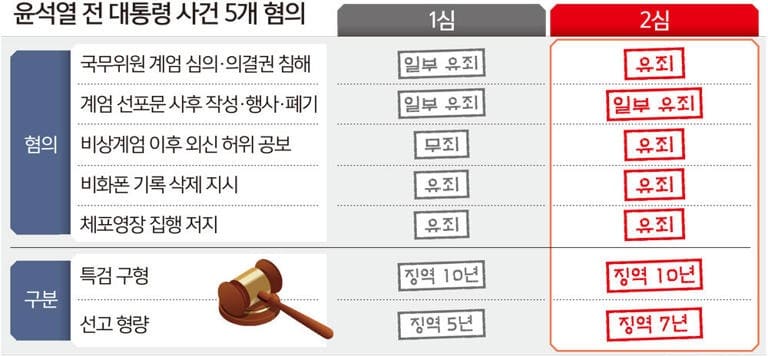
Former President Yoon Suk Yeol was sentenced to seven years in prison in his appeal trial for obstructing the execution of an arrest warrant. This is two years longer than the sentence in the first trial. The appellate court expanded the scope of responsibility by recognizing as guilty key charges that had been acquitted in the first trial, including ordering false press guidance for foreign media and infringing on cabinet members’ deliberation rights. A day earlier, Kim Keon Hee was also sentenced to four years in prison on appeal, resulting in increased sentences for both.

🔹 Seven-year sentence…first ruling by special insurrection panel
The Seoul High Court Criminal Division 1 (Presiding Judge Yoon Sung-sik) sentenced Yoon to seven years in prison on April 29 in his appeal trial on charges including obstruction of official duties and abuse of power. This represents an increase of two years from the five-year sentence in the first trial.
This ruling carries symbolic significance as the first decision by the special insurrection panel established in February. It is expected to serve as an important benchmark for future cases involving high-level political crimes and constitutional order.
The special prosecution team led by Cho Eun-seok sought a 10-year sentence, the same as in the first trial. However, the court imposed a heavier sentence than the lower court, reflecting an unfavorable outcome for the defendant despite considering certain mitigating factors.
🔹 Obstruction of arrest warrant execution…violation of rule of law
Yoon was indicted for mobilizing Presidential Security Service personnel in January of last year to block the execution of an arrest warrant by the Corruption Investigation Office for High-ranking Officials.
The appellate court upheld the guilty verdict from the first trial.
The court stated that even if there are disputes over investigative authority, physically obstructing the execution of a court-issued warrant violates the rule of law.
It also clarified that presidential immunity from prosecution limits indictment but does not prohibit investigation itself, thereby recognizing the investigative authority of the agency.
The court further noted that abuse of authority is subject to judicial review and cannot be considered a violation of the separation of powers.
🔹 Secure phone record deletion order…crime without result required
Yoon was also charged with ordering the deletion of secure phone communication records through the Presidential Security Service.
Although his defense argued that no actual deletion occurred, the appellate court rejected this claim.
The court ruled that under the Presidential Security Act, abuse of authority does not require the occurrence of a result, and the act of issuing the order itself constitutes a crime.
This establishes an important legal principle that focuses on the illegality of the act itself rather than the outcome.
🔹 Martial law document fabrication and destruction recognized
Yoon was also charged with drafting and destroying a false proclamation document after the lifting of martial law.
The document included signatures from the Prime Minister and Defense Minister, making it appear as though martial law had been declared through proper procedures.
The court recognized this as the creation of a false official document and destruction of public records, and found him guilty.
However, due to lack of evidence that the document was actually used, the charge of exercising the document was acquitted.
🔹 False foreign press guidance and cabinet rights violation overturned to guilty
Yoon was accused of ordering a senior official to prepare and distribute press guidance containing false information to foreign media.
The guidance reportedly included claims that access to the National Assembly had not been blocked.
While the first trial acquitted this charge, the appellate court overturned it and found him guilty.
The court stated that the act concealed the illegality of the martial law declaration and disseminated false information internationally, potentially damaging national credibility and the public’s right to know.
Additionally, the court found that convening a cabinet meeting at a time when certain ministers could not attend constituted a violation of their deliberation rights.
This ruling recognized both procedural flaws and intentional misconduct.
🔹 Kim Keon Hee sentenced to 4 years…stock manipulation, bribery, and polling cases addressed comprehensively
A day earlier, Kim Keon Hee was also sentenced in her appeal trial.
The Seoul High Court Criminal Division 15-2 (Presiding Judge Shin Jong-oh) sentenced her to four years in prison and imposed a fine of 50 million won. The court also ordered the confiscation of a diamond necklace worth 62.2 million won and an additional forfeiture of 20.94 million won.
This represents a significant increase from the first trial sentence of one year and eight months.
The appellate court overturned the acquittal of her involvement in the Deutsche Motors stock manipulation case.
The court found that she provided a securities account containing approximately 2 billion won to Black Pearl Invest and formed a collusive relationship with stock manipulation forces.
It stated that the agreement to share 40% of profits could not be seen as a simple investment return but rather as compensation for artificially inflated stock prices.
The court also determined that she was at least aware of the possibility that her account could be used for stock manipulation, thereby recognizing her as a co-principal offender.
Her involvement in receiving luxury goods related to the Unification Church was also found guilty.
The court ruled that receiving a Chanel bag in April 2022 could not be considered a simple congratulatory gift given its timing before the presidential inauguration.
Even without explicit solicitation, the court recognized implicit solicitation, as she could have anticipated future demands for compensation.
The July 2022 receipt of another Chanel bag and a Graff diamond necklace was also upheld as guilty.
However, the charge of illegally receiving free polling data from political broker Myung Tae-kyun was acquitted due to lack of evidence.
The court found insufficient proof of prior agreement or request for polling and did not 인정 any quid pro quo related to nomination decisions.
🔹 Increased sentences for both…expanding legal risks
Former President Yoon’s sentence increased from five years in the first trial to seven years, while Kim’s sentence rose from one year and eight months to four years. Both cases share the common feature that acquittals in the first trial were overturned on appeal, directly leading to heavier sentences.
In particular, for Yoon, additional illegality was recognized in the exercise of power, including ordering false press guidance to foreign media and infringing on cabinet members’ deliberation rights. For Kim, the scope of responsibility was expanded across stock manipulation conspiracy and the receipt of illicit valuables. This was not merely the addition of a few charges, but rather reflects that the court’s evaluation of the overall structure of the crimes became significantly stricter than in the first trial.
As a result, both now face considerable legal uncertainty until a final ruling by the Supreme Court. Beyond political influence, the expansion of criminal liability, combined with their status as a former presidential couple, has led to an assessment that their legal risks have simultaneously intensified.
Moreover, the fact that these cases were not isolated but instead involve concurrent findings of guilt in both the exercise of state power and the pursuit of private benefit carries broader implications. In the legal community, there is analysis that this case demonstrates a trend toward stricter judicial standards in handling high-level power-related crimes.
🔹 Court criticism…“failed presidential duty”
In explaining the sentencing rationale, the appellate court strongly criticized former President Yoon’s responsibility.
The court stated that “the defendant, as the sitting president at the time, bore the highest responsibility to uphold the Constitution and protect the freedoms and rights of the people, yet failed to fulfill that duty.” It further concluded that “this case intensified social confusion and deepened national division and conflict.”
This goes beyond a simple judgment of individual criminal acts and is interpreted as an evaluation of criminal liability based on the public responsibilities inherently required by the office of the president. In other words, sentencing was determined on the premise that the president carries a significantly higher level of legal and ethical responsibility than ordinary public officials.
The court also pointed out that the false press guidance and actions related to martial law could have had repercussions beyond domestic affairs, potentially affecting the country’s credibility in the international community. This reflects a judgment that considers the broader impact of presidential actions, recognizing a level of seriousness beyond ordinary illegality.
Legal experts suggest that this ruling may serve as a precedent clarifying the principle of “aggravated responsibility based on position” in future cases involving abuses of power.
🔹 Appeal to Supreme Court
Yoon’s legal team immediately announced their intention to appeal following the appellate court ruling.
The defense stated that “there remain substantial legal grounds to contest,” particularly regarding the recognition of abuse of power, the acknowledgment of the Corruption Investigation Office’s investigative authority, and the ruling on false press guidance. They indicated their plan to seek a final determination from the Supreme Court.
Kim’s legal team has expressed a similar position, suggesting the possibility of appeal on the grounds that there were legal misunderstandings in recognizing conspiracy in stock manipulation and the concept of implicit solicitation.
Accordingly, both cases are expected to proceed to the Supreme Court for final judgment. Since the Supreme Court primarily reviews legal interpretations rather than factual determinations, key issues are likely to include the recognition of “collusion,” the scope of “abuse of power,” and the legal standards for “implicit solicitation.”
Given the significant political and social implications of these cases involving a former president and his spouse, the Supreme Court’s final ruling is likely to establish an important precedent for similar cases in the future.
In the legal community, there is a prevailing view that, with much of the factual determination solidified at the appellate level, the Supreme Court’s review will focus on the appropriateness of legal interpretations.
One-line summary : Yoon Suk Yeol and Kim Keon Hee were sentenced to 7 and 4 years respectively on appeal, with key acquitted charges overturned to guilty.
728x90
반응형
그리드형(광고전용)
'오늘의 일들 > Korea Today's News' 카테고리의 다른 글
| [26.05.01] Mass Crowd Forces Suspension of Pokémon Event in Seongsu (0) | 2026.05.01 |
|---|---|
| [26.04.30] Hyun Joo-yup Accuser Found Not Guilty Again on Appeal (0) | 2026.04.30 |
| [26.04.28] Kim Keon-hee Gets 4 Years on Appeal (0) | 2026.04.28 |
| [26.04.27] Sawe Breaks Marathon’s Two-Hour Barrier for the First Time…1:59:30 (0) | 2026.04.27 |
| [26.04.26] Gunshots at Trump Dinner, Suspect Allen Arrested (0) | 2026.04.26 |
댓글 영역