고정 헤더 영역

상세 컨텐츠
본문 제목
[26.05.23] Starbucks Korea Boycott Grows Over “Tank Day” Controversy
본문
반응형
Starbucks Korea Faces Nationwide Boycott Over “Tank Day” Controversy
📍Public backlash over promotions linked to the May 18 Democratic Uprising spreads across labor unions, universities, civic groups, and government agencies
Starbucks Korea is facing escalating nationwide backlash after its controversial “Tank Day” promotion triggered accusations of mocking the May 18 Democratic Uprising and other painful moments in modern Korean history. As criticism intensified, labor unions, university groups, civic organizations, and government ministries launched boycott campaigns and began distancing themselves from the company. Internal employee complaints and whistleblower posts have further expanded the controversy into a broader debate over corporate responsibility, historical awareness, and internal management failures.
🔹 “Tank Day” Controversy Expands Into National Debate
The controversy began after Starbucks Korea launched a promotional campaign called “Tank Day” on May 18.
The company promoted products including the “Color Tank Tumbler Set” and “Tank Duo Set,” while using the slogan “Bang on the Desk!” in promotional materials.
Criticism erupted immediately online. Because May 18 marks the anniversary of the 1980 May 18 Democratic Uprising in Gwangju, many users argued that the word “tank” evoked memories of armored military vehicles deployed by the military regime during the crackdown.
The slogan “Bang on the Desk!” also drew criticism for reminding the public of the infamous police explanation following the 1987 torture death of student activist Park Jong-chul, when authorities claimed that he had died after officers “banged the desk.”
Online communities and social media users argued that the overlap between the historical date and the controversial expressions was too severe to dismiss as a simple mistake.
Many critics said it was difficult to believe that such historically sensitive language could pass through multiple corporate review processes without anyone recognizing the implications.
🔹 Organized Boycott Campaigns Spread Across Universities and Labor Unions
Following the controversy, organized boycott campaigns rapidly spread among university groups and public-sector labor unions.
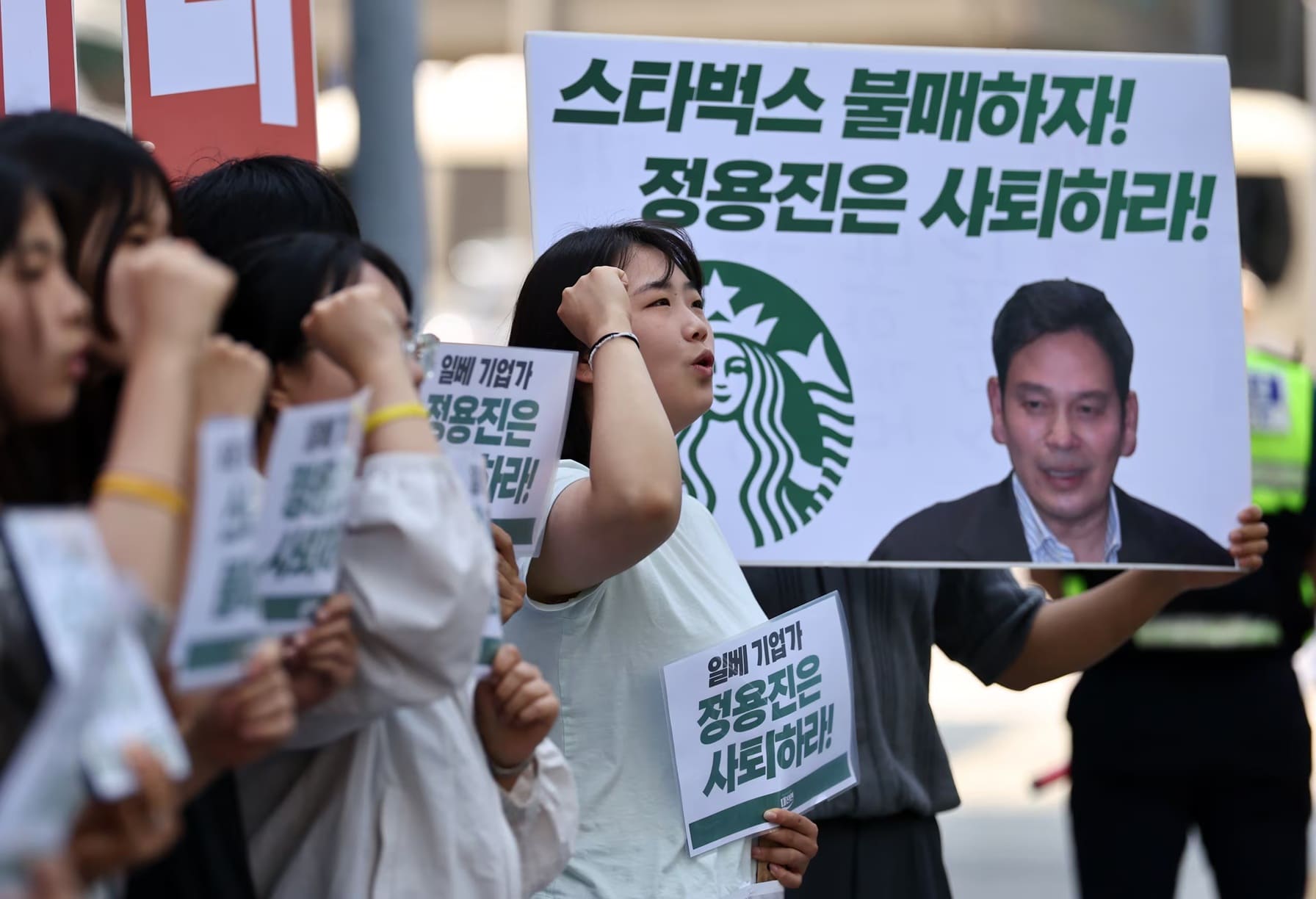
The Korean University Progressive Alliance held a press conference outside Starbucks Korea headquarters in Seoul on May 23 and demanded the resignation of Shinsegae Group Chairman Chung Yong-jin.
The organization declared the beginning of an official boycott campaign, arguing that both the company and its leadership should be held accountable for allegedly mocking painful chapters of Korean history.
The student group also referenced Chung’s past anti-communist remarks and controversies involving support for conservative organizations, claiming the incident reflected deeper problems within the company’s leadership culture.
Public-sector unions soon joined the movement.
The Korean Government Employees’ Union distributed notices to branches nationwide recommending that members stop using Starbucks products.
The union argued that phrases such as “Tank Day” and “Bang on the Desk!” could be interpreted as anti-democratic expressions that trivialized or mocked victims of Korea’s democratization movement.
Other public employee federations also encouraged members to avoid Starbucks gift cards and participate in boycott activities.
🔹 Government Ministries Review Starbucks Partnerships and Purchases
Government ministries also began reviewing their use of Starbucks products and related partnerships following the controversy.
The Ministry of Justice reportedly instructed the Supreme Prosecutors’ Office to submit records of Starbucks-related purchases made this year.
The review reportedly included tumblers, gift certificates, and mobile gift coupons, although ordinary beverage purchases were excluded.
Some legal observers interpreted the move as a sign that government institutions were attempting to distance themselves from the brand amid growing public criticism.
The Ministry of Justice later clarified that the review was not intended for disciplinary action against individual employees.
Meanwhile, the Ministry of National Defense suspended an ongoing welfare partnership project involving Starbucks Korea, and the Ministry of Health and Welfare reportedly began reviewing plans to halt a senior barista competition connected to the company.
Several ministers also expressed regret through social media posts and stated that Starbucks products would no longer be used at certain government events.
🔹 President Lee Jae-myung Says Incident “Difficult to View as Accidental”
President Lee Jae-myung also issued strong criticism regarding the controversy.
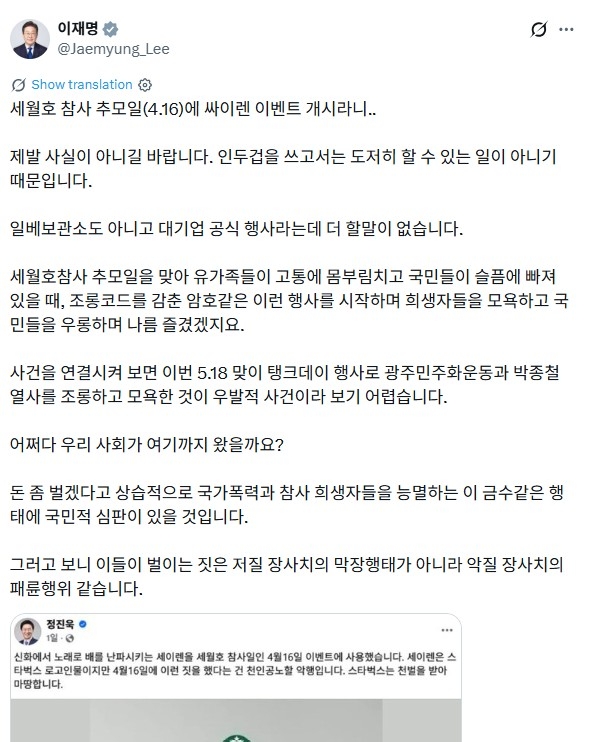
Through social media, Lee referenced allegations that Starbucks had previously launched a “Siren” promotional event on April 16, the anniversary of the Sewol ferry disaster.
He argued that the repeated use of marketing campaigns linked to historically tragic dates made it difficult to view the incidents as accidental mistakes.
Lee stated that planning such events on days associated with national mourning and grieving families demonstrated disregard for public sentiment.
He further criticized what he described as attempts to commercialize memories of state violence and national tragedy for profit, warning that the company would face public judgment.
The president also questioned whether the controversy reflected broader problems in the company’s understanding of Korean history and social responsibility.
🔹 Internal Employee Posts Reveal Fallout Inside Starbucks
As the controversy continued to grow, internal employee complaints and whistleblower-style posts also spread online.
On the anonymous workplace platform Blind, a user claiming to be a Starbucks Korea employee wrote that thousands of frontline workers were suffering because of decisions made by a small number of planners.
The writer stated that store employees were being forced to apologize to angry customers for actions they had no involvement in.
According to the post, store managers were revising sales projections and staffing schedules while concerns about contract renewals and reduced performance bonuses were spreading internally.
The employee described the atmosphere inside stores as deeply demoralized.
The post also claimed that while some executives had been punished, individuals directly involved in planning the campaign were allegedly denying intentional wrongdoing.
Additional comments criticizing the company’s internal hiring and review systems also gained attention online.
The writer urged headquarters to prioritize integrity and accountability over personal connections or academic background when hiring and promoting staff.
🔹 Civic Protests and Product Boycott Campaigns Continue
Civic groups in Gwangju and South Jeolla Province also organized protests condemning Starbucks Korea and Shinsegae Group.
The organizations accused the company of turning the painful history of Korea’s democratization movement into a commercial marketing tool and demanded stronger accountability measures.
Online boycott campaigns also intensified.
Some consumers posted photos of themselves throwing away or destroying Starbucks tumblers and cups while announcing they would no longer support the brand.
Others shared instructions for refunding mobile gift coupons and encouraged people to switch to local coffee shops instead of visiting Starbucks locations.
Comments criticizing the social image of giving Starbucks gift cards also spread across social media.
🔹 Starbucks Appeals for Protection of Frontline Employees
As criticism intensified, Starbucks Korea distributed another apology statement to stores nationwide.
The company apologized to victims and families connected to the May 18 Democratic Uprising and stated that the controversy originated from mistakes made during online business operations rather than actions by store employees.
Starbucks also urged the public to refrain from directing anger and criticism toward frontline workers at stores.
However, with boycott campaigns continuing across online communities, labor unions, universities, and civic groups, observers say the controversy is unlikely to fade quickly.
One-line summary : The Starbucks Korea “Tank Day” controversy has expanded into a nationwide boycott movement and a broader debate over corporate historical awareness and responsibility.
728x90
반응형
그리드형(광고전용)
댓글 영역