고정 헤더 영역

상세 컨텐츠
본문 제목
[26.05.24] Election Banner Pollution Controversy Grows Amid Safety Concerns
본문
반응형
Election Banner Pollution Controversy Grows Ahead of Local Elections
📍As campaign banners flood streets nationwide during the local election season, safety accidents and complaints over obstructed visibility continue to grow
As official campaigning for South Korea’s June 3 nationwide local elections intensifies, streets across the country are becoming increasingly crowded with campaign banners. Political parties and candidates are competitively installing large banners at major intersections, roadsides, and alley entrances with heavy pedestrian traffic. However, criticism is mounting that the excessive spread of campaign banners is not only damaging city aesthetics but also threatening the safety of pedestrians and drivers. Following a series of accidents involving collapsing structures and dangerous banner ropes, the recurring issue of “banner pollution” during election seasons has once again emerged as a major social controversy.

🔹 Recurring “Banner Pollution” During Every Election Season
Complaints about campaign banners have become one of the most common public grievances during election periods in South Korea. Large numbers of political party banners, candidate advertisements, and voting participation banners are often concentrated along major roads, intersections, and neighborhood entrances, leading to repeated criticism that they damage the urban landscape while creating serious risks for both pedestrians and drivers.
In many areas, banners are installed haphazardly around trees, utility poles, and safety fences. Multiple banners are often crowded into a single location, obstructing visibility for motorists and pedestrians alike. Drivers have complained that campaign banners make it difficult to secure a clear line of sight at intersections, while pedestrians say support ropes and installation structures along sidewalks have made ordinary walking routes more dangerous.
The intense competition among candidates to secure so-called “prime advertising locations” has also become a recurring issue during every election season. Some candidates reportedly install ordinary political party banners before the official campaign period begins and later replace them with campaign advertisements once electioneering officially starts. Critics have described the tactic as a form of “claiming prime spots in advance.”
🔹 Government Strengthens Campaign Advertisement Regulations
South Korea’s Ministry of the Interior and Safety announced on April 29 that it would strengthen campaign advertisement management standards ahead of the 9th nationwide local elections. The ministry coordinated with the National Election Commission to establish detailed “Campaign Advertisement Management Guidelines,” which were distributed to local governments and political parties on April 15.
According to the guidelines, officially approved campaign banners for candidates and political parties are exempt from certain permit and registration requirements under the Outdoor Advertising Act. However, banners encouraging voter participation, fundraising notices, post-election thank-you banners, and advertisements for campaign support offices remain subject to existing outdoor advertising regulations and must comply with permit and registration rules.
The guidelines also state that advertisements related to party primaries, preliminary candidates, campaign organizations, and political party offices will be managed under the responsibility of candidates and political parties themselves. However, if public complaints arise or safety risks such as collapsing banners or damaged structures occur, local governments may demand immediate corrective action. If those demands are ignored, authorities may remove the banners under outdoor advertising laws.
Based on the new guidelines, the Ministry of the Interior and local governments launched a nationwide inspection campaign targeting illegal outdoor advertisements from May 4 through June 2. Authorities are reviewing whether campaign advertisements comply with installation standards and political banner regulations. Officials stated that banners violating regulations will first be subject to requests for voluntary removal or relocation, but local governments may directly remove them if corrective measures are not taken.
🔹 Strong Winds, Collapsing Structures, and Serious Injuries Raise Safety Concerns
A growing number of accidents involving campaign banners has intensified public concern. According to the Ministry of the Interior and local governments, the rapid increase in banners around busy intersections and pedestrian crossings since official campaigning began has significantly increased risks for pedestrians.
In a recent incident in Wonju, Gangwon Province, a massive campaign banner structure attached to the exterior wall of a building collapsed after failing to withstand strong winds. The approximately 25-meter banner and its steel support structure bent and crashed toward the roadway. Although no major injuries were reported, nearby vehicles and pedestrians narrowly avoided what could have become a serious accident.
Pedestrian accidents have also occurred. On April 25 in Pocheon, Gyeonggi Province, an elementary school student crossing a street became entangled in a campaign banner support rope installed near the roadside. The thin white rope, tied at approximately one meter above ground level, was reportedly difficult to notice. The student fell and suffered a serious skull fracture, requiring emergency medical treatment.
Concerns are also growing regarding child protection zones. Under current law, campaign banners are prohibited inside school safety zones. However, complaints continue in some areas that campaign banners installed near traffic signals and school zone signs obstruct children’s visibility. Because young children are shorter, they may struggle to see approaching vehicles around large banners, while drivers may also fail to notice children suddenly entering crosswalks.
🔹 Illegal Political Banner Crackdowns Surpass 100,000 Cases
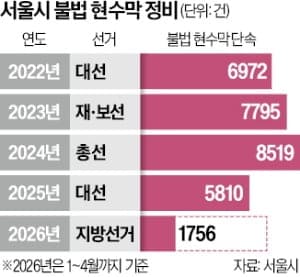
The number of illegal political banner violations has risen sharply in recent years. According to the Ministry of the Interior and Safety, authorities cracked down on 102,238 illegal political banners last year. That figure represents an approximately 84 percent increase compared to 55,571 cases recorded in 2024.
Seoul City alone removed 5,810 illegal banners last year. Among them, 992 were political party banners, making them the second most common category after commercial advertisements.
Despite intensified enforcement efforts, officials say there are clear limits to what inspections alone can accomplish. Seoul City has deployed 639 temporary workers dedicated to collecting and removing illegal banners, but authorities acknowledge that the sheer volume of campaign advertisements during election season continues to overwhelm enforcement capacity.
Safety concerns involving workers who install and remove banners have also emerged as a major issue. According to the Ministry of Employment and Labor, there have been 350 industrial accidents related to banner installation work since 2022, including 173 falls. In one recent case, a worker fell approximately 2.5 meters after a deteriorated ladder platform broke while he was installing a campaign banner on the exterior wall of a building.
🔹 “Campaign Promotion Must Not Endanger Public Safety”
Experts say political campaigning is an essential part of democratic elections but stress that public safety and order must take priority.
Kim Jun-mo said, “Campaign promotion is necessary, but it should never endanger citizens or children. Political parties themselves must establish stricter installation standards, and voters should also hold candidates accountable for reckless banner placement.”
He added that reducing election-season banner pollution will require not only stronger enforcement but also greater restraint from political parties and broader public awareness.
One-line summary : As campaign banners rapidly spread ahead of the June 3 local elections, growing safety accidents and visual clutter are fueling public concern and criticism.
728x90
반응형
그리드형(광고전용)
댓글 영역