고정 헤더 영역

상세 컨텐츠
본문
반응형
Jamsil Vote-Counting Center Protest Enters Fourth Day as Youth National Team Players Blocked and Subjected to Bag Inspections
📍Protest shifts back toward election conspiracy claims as youth handball players and a foreign journalist become caught up in escalating tensions
The blockade protest at the Jamsil vote-counting center, sparked by controversy surrounding ballot shortages during the June 3 local elections, entered its fourth day on June 8. What had briefly appeared to be a movement focused on demanding a re-election has increasingly shifted back toward election conspiracy claims. Public criticism intensified after protesters blocked youth national team athletes from entering the venue to retrieve training equipment and later subjected them to bag inspections. Concerns are also growing over increasingly confrontational behavior after a foreign journalist was surrounded and questioned by protesters at the scene.
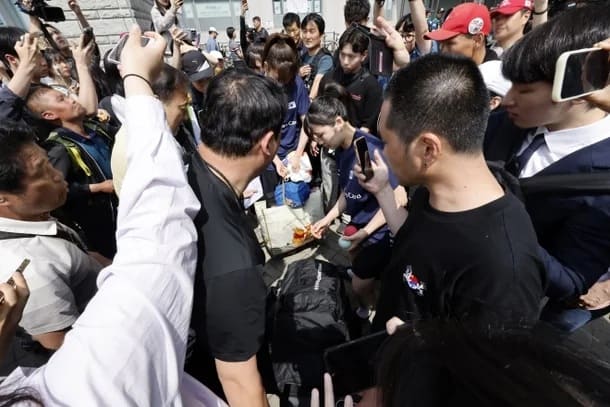

🔹 Fourth Day of the Vote-Counting Center Blockade
Approximately 1,600 protesters, according to unofficial police estimates, gathered outside the Handball Gymnasium at Olympic Park in Seoul’s Songpa District on June 8.
Participants continued occupying and blocking entrances surrounding the facility, which has been serving as a vote-counting center.
The protest began after reports emerged of ballot shortages during the June 3 local elections. Protesters argued that serious failures occurred in the election management process and demanded a full investigation and accountability from election officials.
In its early stages, the movement largely focused on allegations of election mismanagement and calls for a re-election. Some participants even advocated minimizing partisan messaging in order to attract broader public support.
However, the atmosphere at the protest site has changed significantly as the demonstration has continued.
🔹 From “Re-Election” to “Election Fraud”
Just a day earlier, posters throughout the protest site encouraged participants to unify their message around demands for a re-election.
Some protesters had also called for avoiding politically charged slogans and the display of foreign flags.
By June 8, however, the mood had shifted dramatically.
Participants waving both South Korean and American flags repeatedly chanted slogans such as “Election Fraud” and “Re-Election Now,” while references to the American political slogan “Stop the Steal” became increasingly common.
Rumors circulated rapidly through group messaging channels claiming that efforts to discourage election-fraud rhetoric were being directed by outside organizations seeking to influence the protest.
Some protesters argued that external groups were attempting to alter the movement’s direction, and new posters appeared throughout the site warning participants to remain vigilant against alleged outside interference.
Others cautioned that spreading conspiracy theories and targeting supposed infiltrators would only divide the movement.
Nevertheless, the central focus of the protest appeared to shift away from ballot shortages and toward broader election-fraud allegations.
🔹 Internal Divisions Surface Among Protesters
The protest also revealed growing internal disagreements over its future direction.
Some participants insisted that focusing on the ballot-shortage issue and demands for a re-election would make it easier to gain public sympathy.
Others countered that the ballot shortage could not be separated from broader allegations of election fraud.
Debates intensified over claims that outside organizations were attempting to manipulate the protest.
Accusations of infiltration and calls to identify supposed external actors contributed to a growing atmosphere of distrust among participants.
As a result, attention increasingly shifted away from the original election-administration concerns and toward arguments over conspiracy theories and internal divisions.
🔹 “Please” — Youth National Team Players Prevented from Entering
The most controversial incident of the day involved six members of South Korea’s youth women’s handball national team.
The athletes are currently preparing for the 25th IHF Women’s Junior World Championship (U20), scheduled to begin on June 24 in Jinzhong, Shanxi Province, China.
The Handball Gymnasium had originally been designated as their training venue. However, ongoing protests surrounding the vote-counting center forced training sessions to be relocated to the nearby Korea National Sport University.
Despite the venue change, official match balls and training equipment remained stored inside the gymnasium, requiring the athletes to retrieve them in person.
Wearing national team uniforms, the players arrived with coaching staff and explained that they needed access to the facility in order to collect equipment for training.
Some protesters refused to accept their explanation.
Questions such as “How do we know they are really handball players?”, “Can they show us game footage?”, and “Why do they need those particular balls?” were reportedly directed at the athletes.
Police officers repeatedly requested cooperation from protesters, but the standoff continued.
Eventually, after one athlete clasped her hands together and pleaded, saying “Please,” the group was allowed to enter the building.
🔹 Bag Inspections Trigger Further Controversy
The situation escalated further when the athletes exited the facility.
At approximately 10:24 a.m., the players emerged carrying carts filled with official handballs and other training equipment.
Several protesters approached them and demanded inspections of their bags and belongings.
Participants claimed they needed to verify that ballots or other alleged evidence of election fraud were not being removed from the building.
The athletes, many around 20 years old, appeared visibly uncomfortable as the inspections took place.
Witnesses said several players looked shocked and intimidated during the encounter.
The controversy deepened when one male protester reportedly suggested that the athletes should remove their socks for inspection as well.
Police officers immediately intervened, warning that such remarks could cause humiliation and constitute inappropriate conduct.
🔹 Foreign Journalist Also Questioned
A foreign journalist was involved in a separate confrontation later that morning.
While reporting outside the venue in what appeared to be Chinese, the journalist attracted the attention of several protesters.
A group gathered around and questioned the reporter’s identity, with some asking whether the individual was Chinese or conducting undercover reporting.
Participants reportedly sought someone capable of translating the language being spoken.
After approximately five minutes, the journalist identified themselves as a member of a Taiwanese media organization, and the situation was eventually resolved.
Observers expressed concern that a reporter was subjected to collective suspicion simply because of the language being spoken.
🔹 Sports Community Raises Concerns
Officials within the handball community expressed growing concern about the impact of the protest on athletes preparing for international competition.
A coach accompanying the players said that while a disruption lasting a day or two could be managed, a protest continuing for weeks would create serious difficulties.
“Training locations can be changed, but the equipment is essential,” the coach explained.
With the World Junior Championship only weeks away, sports officials warned that disruptions to training schedules could affect athlete preparation and performance.
Many in the sporting community argued that regardless of political disagreements, athletes preparing to represent the country should not become collateral damage in ongoing protests.
🔹 Growing Concerns Over Escalating Social Tensions
What began as a protest over ballot shortages has evolved into a broader social controversy.
As election-fraud allegations, conspiracy theories, and efforts to identify supposed outside actors become increasingly prominent, concerns are mounting over the impact on ordinary citizens and public institutions.
The incidents involving youth national team athletes and a foreign journalist have become symbols of how the situation may continue to escalate if the protest remains unresolved.
Critics argue that while citizens have the right to protest, actions that interfere with athletes, journalists, and members of the public risk deepening social divisions and undermining the legitimacy of the movement itself.
One-line summary : As the Jamsil vote-counting center protest entered its fourth day, controversy intensified after youth national handball players were blocked from retrieving training equipment and subjected to bag inspections.
728x90
반응형
그리드형(광고전용)
'오늘의 일들 > Korea Today's News' 카테고리의 다른 글
| [26.06.10] Tving Data Breach Affects 13 Million Users (0) | 2026.06.10 |
|---|---|
| [26.06.09] 7,194 Ballots Found Short in June 3 Local Elections (0) | 2026.06.09 |
| [26.06.07] Jensen Huang’s Korea Visit and Executive Meetings (0) | 2026.06.07 |
| [26.06.06] Won-Dollar Exchange Rate Tops 1,560 (0) | 2026.06.06 |
| [26.06.05] Ballot Shortage Fallout: NEC Leaders Step Down, Clashes Continue (0) | 2026.06.05 |
댓글 영역