고정 헤더 영역

상세 컨텐츠
본문
반응형
Won-Dollar Exchange Rate Surges Above 1,560, Highest Level in 17 Years
📍Strong U.S. jobs data fuels dollar rally as foreign capital outflows and prolonged Middle East conflict add pressure on the Korean won
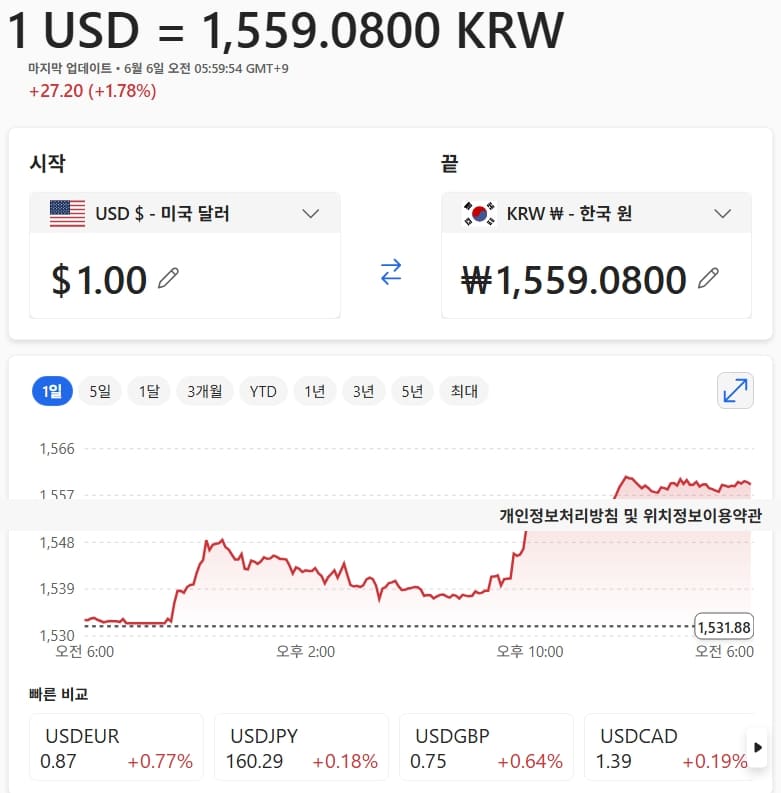
The South Korean won weakened sharply against the U.S. dollar, with the won-dollar exchange rate briefly surpassing 1,560 won during overnight trading on June 6, reaching its highest level in more than 17 years since the global financial crisis. Market analysts attributed the surge to stronger-than-expected U.S. employment data, rising expectations of additional Federal Reserve rate hikes, continued foreign investor selling in Korean equities, and growing geopolitical risks stemming from the prolonged conflict in the Middle East.

🔹 Won-Dollar Exchange Rate Breaks Above 1,560
According to the Seoul foreign exchange market, the won-dollar exchange rate closed at 1,559.0 won during overnight trading at 2:00 a.m. on June 6.
The rate rose 19.9 won from the previous day's daytime closing level of 1,539.1 won. Just before the overnight session ended, the exchange rate climbed further and briefly touched 1,561.5 won.
It marked the first time the won-dollar exchange rate had exceeded the 1,560-won level since March 6, 2009, when it reached an intraday high of 1,597.0 won during the global financial crisis.
Earlier in the day, the exchange rate had already shown signs of instability, rising to 1,549.1 won during daytime trading before closing at 1,539.1 won.
🔹 Strong U.S. Employment Report Sparks Dollar Rally
The immediate catalyst behind the sharp increase was the release of stronger-than-expected U.S. employment data.
The U.S. Department of Labor reported that nonfarm payroll employment increased by 172,000 in May compared with the previous month.
The figure significantly exceeded market expectations of approximately 80,000 new jobs.
Meanwhile, the unemployment rate remained unchanged at 4.3 percent, indicating continued resilience in the U.S. labor market.
Following the report, financial markets increasingly priced in the possibility that the Federal Reserve may maintain its tight monetary policy stance for longer and could even consider another interest rate increase later this year.
As a result, demand for the U.S. dollar strengthened sharply across global markets.
🔹 Federal Reserve Rate Hike Expectations Increase
Market participants interpreted the strong employment figures as evidence that the U.S. economy remains resilient despite elevated borrowing costs.
The stronger labor market reduced expectations for near-term monetary easing and increased speculation that the Federal Reserve would prioritize inflation control over rate cuts.
According to CME FedWatch data, futures markets are now pricing in a greater-than-70 percent probability that the Federal Reserve could raise interest rates again before the end of the year.
The shift in expectations triggered a broad rally in U.S. Treasury yields.
The 30-year Treasury yield climbed above 5.0 percent during trading, while the benchmark 10-year yield surpassed 4.5 percent.
The two-year Treasury yield also rose to its highest level since February of last year.
🔹 Dollar Index Returns Above 100
The stronger outlook for U.S. interest rates fueled a broad-based appreciation of the U.S. dollar.
The U.S. Dollar Index (DXY), which measures the dollar against six major currencies, climbed above the psychologically important 100 level for the first time in roughly two months.
The index had remained below 100 since April but rebounded sharply following the release of the U.S. employment report.
A stronger dollar typically increases downward pressure on emerging-market currencies, including the Korean won.
🔹 Foreign Selling and Middle East Risks Weigh on the Won
Domestic factors also contributed to the weakening of the Korean currency.
Foreign investors continued to sell Korean stocks, generating additional demand for dollars and placing pressure on the won.
At the same time, concerns over the prolonged conflict in the Middle East increased demand for safe-haven assets such as the U.S. dollar.
Market participants also cited concerns about higher energy import costs if geopolitical tensions continue to disrupt global oil markets.
These factors combined to accelerate the depreciation of the Korean currency against the dollar.
🔹 Won Falls More Than 100 Won in One Month
The speed of the currency's decline has drawn particular attention.
Compared with the daytime closing rate of 1,455.1 won on May 6, the won-dollar exchange rate has risen by more than 100 won within a single month.
Such a rapid depreciation is considered unusual even by historical standards and reflects the combined impact of global monetary tightening expectations and domestic market pressures.
Financial markets are closely monitoring whether the exchange rate will remain above the 1,550-won level or move even higher in the coming weeks.
🔹 Volatility Expected to Continue
Currency strategists warn that exchange-rate volatility could remain elevated if U.S. interest rates stay higher for longer than previously anticipated.
A persistently strong dollar, continued foreign capital outflows, and ongoing geopolitical uncertainty could maintain pressure on the Korean won in the near term.
While authorities are closely monitoring market conditions, investors remain focused on upcoming U.S. inflation and employment data, which could further influence expectations for Federal Reserve policy and the direction of the won-dollar exchange rate.

One-line summary : The won-dollar exchange rate briefly surpassed 1,560 won for the first time in 17 years as strong U.S. employment data, rising Federal Reserve rate-hike expectations, foreign capital outflows, and Middle East tensions boosted demand for the U.S. dollar.
728x90
반응형
그리드형(광고전용)
댓글 영역