고정 헤더 영역

상세 컨텐츠
본문 제목
[26.03.19] Controversy Over Public Mobilization Ahead of BTS Gwanghwamun Concert
본문
반응형
“Why Should BTS Take Away My Day Off?”…Controversy Expands Over Public Official Mobilization and Public Resource Use Ahead of Gwanghwamun Concert
📍Controversy over public official mobilization and public resource use grows ahead of BTS Gwanghwamun concert, spreading to traffic control, business impact, and labor conflicts
Ahead of BTS’s large-scale concert at Gwanghwamun Square, controversy surrounding the mobilization of public officials and the use of public resources is rapidly spreading. As up to 260,000 people are expected to gather, the government and local authorities have begun large-scale safety management and traffic control measures. However, in the process, issues such as the scope of public workforce roles, fairness in cost burden, disruption to citizens’ daily lives and local businesses, and labor rights concerns are becoming intertwined, expanding into a broad social conflict. In particular, debate over how far public systems should intervene in a privately organized event is reigniting, and this concert is emerging as a social issue beyond a simple cultural event.
🔹 Internal Backlash Among Public Officials…“Why Are We Being Mobilized for a Private Event?”
The controversy spread centered on online communities. A post believed to have been written by a lower-level Seoul city official, compiling internal opinions, spread quickly and exposed dissatisfaction within the public sector.
The post contained strong resistance beyond simple complaints. Responses such as “Are we being forcibly mobilized without pay?”, “Why are public officials being deployed for a private company event?”, and “Why should we give up our personal day off because of a concert?” appeared, and some expressed strong frustration by saying “Are we slaves?”
In particular, questions were raised about the compensation system, including overtime pay, travel expenses, and compensatory leave. In a situation where long hours of on-site control and safety management are required, it was confirmed that there is significant distrust over whether compensation is sufficient.
There were also criticisms regarding the legitimacy of deploying public personnel. Points such as “Why are public officials deployed to a private event with a clear organizer?” and “Isn’t the public sector taking over responsibilities that should be handled by the private sector?” were raised. Criticism toward HYBE, the organizer of the concert, also continued, arguing that a private company gains profits while shifting social costs to the public sector, expanding the controversy.
🔹 Seoul City Explanation…“Centered on Voluntary Participation and Compensation System in Place”
Seoul City explained that some claims differ from the facts. According to the city, about 350 public officials will be deployed for this concert, and more than 60 percent of them voluntarily applied in advance.
The remaining personnel were also not randomly assigned but were deployed in minimal numbers centered on departments related to safety and traffic. It was also emphasized that the structure involves about one staff member from each department.
A compensation system is also in place. On-site workers are recognized for more than eight hours of overtime, and they can choose between receiving pay or taking compensatory leave. Seoul City stated that claims of unpaid forced mobilization are not true.
It also emphasized that safety management in large-scale crowd events is a fundamental responsibility of local governments. By citing cases where public officials were deployed in private events such as fireworks festivals, it explained that this measure is not exceptional.
🔹 Escalating Fairness Debate…“Structure Where the Public Sector Bears the Cost”
However, the controversy is expanding beyond factual verification into a structural issue. The key point lies in how much of the cost and responsibility arising from private events should be borne by the public sector.
Some citizens pointed out that “It is unfair that personnel funded by taxes are deployed for an event that is not a state event.” Based on disaster and safety management laws, arguments continued that “the primary responsibility for event safety lies with the organizer.”
There were also opinions that “Even though private security companies and private emergency systems can be utilized, relying on public systems is unfair.” This leads to criticism that the structure allows private entities to take profits while the public sector bears the costs.
Furthermore, some raised concerns that the concentration of ambulances and firefighting personnel may temporarily weaken emergency response capacity for the general public.
🔹 Traffic and Movement Control Realized…Increasing Urban Inconvenience
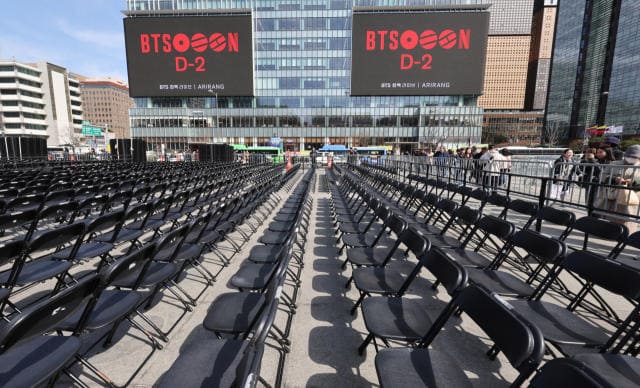
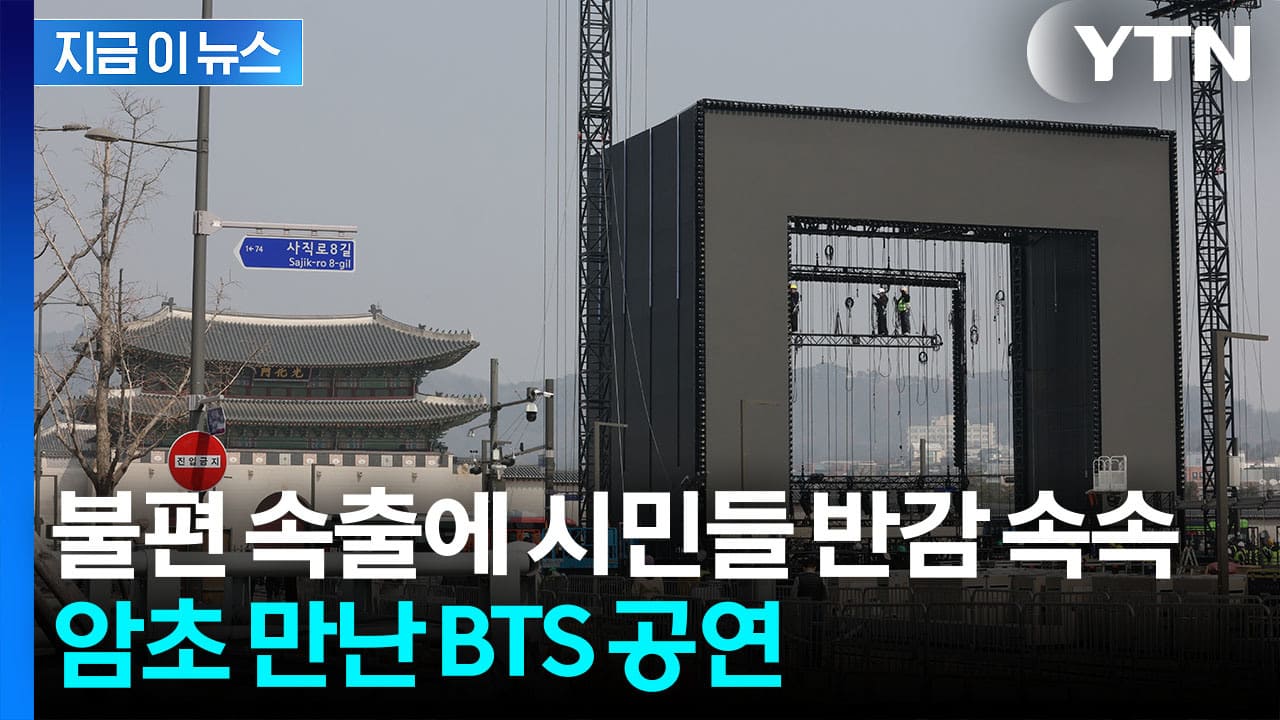
In the Gwanghwamun area, control has already begun in earnest, and inconvenience for citizens is becoming a reality. As safety fences are installed and controlled zones expand, pedestrian routes are restricted, and travel time has increased significantly.
Cases have occurred where sections that usually take two to three minutes now take more than ten minutes, and confusion is continuing due to the lack of detailed route guidance beyond simple “detour” notices.
On the day of the event, control will be further strengthened. The Sejong-daero section between Gwanghwamun and City Hall will be fully controlled, and major roads such as Sajik-ro, Yulgok-ro, and Saemunan-ro will also be blocked by time periods.
Subway stations Gwanghwamun, City Hall, and Gyeongbokgung will pass without stopping, and some entrances will be closed. Bus routes will also be widely diverted, and it is expected to have a major impact on overall urban traffic.
🔹 Business Damage and Corporate Response…“Sales Declining Even Before the Event”
Local commercial districts near Gwanghwamun are also being directly affected. Due to the nature of the area relying on office worker foot traffic, reduced accessibility is leading to declining sales.
Some self-employed business owners complained that “Customers noticeably decreased after the installation of fences,” and that sales decline has already begun even before the event. There are also concerns that as the preparation period lengthens, it may lead to continuous damage beyond short-term losses.
Companies have also begun responding. Some companies decided on early closure or temporary suspension of operations due to safety concerns and congestion, and in this process, cases have occurred where employees were required to take half-day leave or were told not to come to work.
🔹 Labor Rights Controversy Expands…“Forcing Leave May Violate the Law”
The civic group Workplace Gapjil 119 stated that cases of forced annual leave usage related to the concert are being reported.
Under labor law, annual leave should be used at the time requested by workers, and requiring collective usage at a specific time by the employer is only allowed in limited cases.
In addition, if work becomes impossible due to business circumstances, it may be subject to shutdown allowance, but there are criticisms that such standards are not properly applied in reality.
In particular, workplaces with fewer than five employees, freelancers, and platform workers have limited legal protection, making it difficult to guarantee substantive rights.
🔹 Logistics and E-commerce Impact…Delivery Delays Becoming Reality
Large-scale traffic control is also affecting logistics and e-commerce industries. As major roads are blocked, the movement of delivery vehicles is restricted, increasing the likelihood of delays.
Courier companies and platform firms have begun notifying customers in advance, and some services are reviewing plans to temporarily suspend or reduce operations in certain areas.
It is analyzed that a decline in delivery efficiency is inevitable due to limited detour routes.
🔹 “Stadium-Type Control” Introduced…Collision Between Safety and Daily Life
Authorities plan to operate this concert by managing the Gwanghwamun area as a single venue using a “stadium-type crowd control method.”
With up to 260,000 people expected, about 6,500 police officers and firefighting and emergency personnel will be deployed, and high-intensity safety measures such as building access control, rooftop access restrictions, and metal detector installation will be implemented.
In addition, the alert level for terrorism response will be raised, and a joint response system among police, fire authorities, and the military will be strengthened.
This concert is being evaluated as a representative case that goes beyond a simple cultural event and shows how to balance safety in large-scale urban events with citizens’ daily lives, allocation of public resources, and protection of labor rights.
One-line summary : Ahead of the BTS concert at Gwanghwamun, complex social controversies are spreading, including public official mobilization, public resource use, traffic control, business impact, and labor rights issues.
728x90
반응형
그리드형(광고전용)
댓글 영역